Buddhist Meditation: Types, Techniques and How to Start
Buddhist meditation in plain words: what it means, calm and insight, the main techniques and how to begin
Buddhist meditation is the training of the mind that the Buddha taught alongside ethics and wisdom. Its aim is not relaxation for its own sake but a mind calm enough to see clearly, and clear enough to let go of greed, hatred and delusion. This guide explains what the word meditation means in the Buddhist texts, the two qualities that every kind of Buddhist meditation develops, the main techniques taught in the Pali Canon and the Theravada tradition, the Buddha's own summary of four ways to develop concentration, and how to begin with ten or fifteen minutes a day.
What meditation means in Buddhism
The Pali word usually translated as meditation is bhāvanā. It comes from the verb bhavati, 'to become', and means bringing into being or cultivating, the way a farmer grows a crop. The suttas speak of developing the mind (citta-bhāvanā), developing concentration (samādhi-bhāvanā), developing wisdom (paññā-bhāvanā) and developing loving-kindness (mettā-bhāvanā). So Buddhist meditation is less about reaching a special state and more about growing qualities that are already there in small amounts: mindfulness, calm, kindness and understanding.
Meditation is also one part of a larger training. The noble eightfold path places right effort, right mindfulness and right concentration beside right view, right speech and right action, and the Buddha's threefold training is ethics, concentration and wisdom. Without ethics, a meditator sits down with a mind full of regret and agitation; without wisdom, calm becomes no more than a pleasant rest. In Theravada teaching the object the mind works on, such as the breath or the body, is called a kammaṭṭhāna, a 'place of work'.
Calm and insight: the two sides of Buddhist meditation
Every Buddhist meditation technique develops one or both of two qualities: samatha, calm, and vipassanā, insight. The Buddha names them together as the two things that share in true knowledge, and says what each one is for:
Samatho, bhikkhave, bhāvito kamatthamanubhoti?
Cittaṁ bhāvīyati.
Cittaṁ bhāvitaṁ kamatthamanubhoti?
Yo rāgo so pahīyati.
Vipassanā, bhikkhave, bhāvitā kamatthamanubhoti?
Paññā bhāvīyati.
Paññā bhāvitā kamatthamanubhoti?
Yā avijjā sā pahīyati.Mendicants, when calm is developed, what good does it do? The mind is developed. And when the mind is developed, what good does that do? Desire is given up. When insight is developed, what good does it do? Wisdom is developed. And when wisdom is developed, what good does that do? Ignorance is given up.
AN 2.31
Calm settles the mind on one object until the hindrances quiet down and the mind becomes steady, bright and happy. Insight uses that steadiness to watch body and mind as they are, until you see for yourself that everything arises and passes away, cannot satisfy for long, and is not a self. Most teachers combine the two and differ mainly in which comes first. The page samatha vs vipassana compares them point by point.
Types of Buddhist meditation: the main techniques
The Pali Canon and its commentaries describe many techniques, and the Visuddhimagga alone lists forty subjects for calm. Most of them belong to a handful of families. These are the Buddhist meditation techniques you are most likely to meet:
- Mindfulness of breathing (ānāpānassati): feeling the breath as it comes in and goes out, at the nostrils or the abdomen, knowing a long breath as long and a short breath as short. It is the most widely taught method and can lead to both calm and insight. See mindfulness of breathing.
- Mindfulness of the body (kāyagatāsati): knowing your posture, acting with clear awareness, reviewing the parts of the body and the four elements, as set out in the first of the four foundations of mindfulness.
- Loving-kindness (mettā) and the other divine abidings: wishing yourself and others well until goodwill becomes boundless. See metta meditation.
- Recollections (anussati): calling to mind the qualities of the Buddha, the Dhamma and the Saṅgha, your own ethics and generosity, or the certainty of death. In AN 6.10 the Buddha says that while a disciple recollects the Buddha, the mind is not overcome by greed, hatred or delusion, and the gladness this brings leads on to concentration.
- Walking meditation (caṅkama): walking slowly up and down a short path, knowing each step. In AN 5.29 the Buddha lists five benefits of walking meditation, the last being that concentration gained while walking lasts long. See walking meditation.
- Noting: a modern way of doing insight practice in which you give each experience a short mental label at the moment it happens, such as 'rising, falling' for the movement of the abdomen. See noting meditation.
Two more families belong mainly to calm and are usually taken up with a teacher: the kasiṇas, a disc of clay, a bowl of water, a coloured disc or another simple object used as a visual focus, and the contemplation of foulness (asubha), a corpse in its stages of decay. All forty subjects, with the temperament each one suits, are set out on the page 40 meditation subjects.
The four developments of concentration (AN 4.41)
The Buddha once grouped the development of concentration into four kinds according to what each leads to. This short discourse, the Samādhibhāvanā Sutta, is a useful map of Buddhist meditation as a whole, because it shows how the same work of collecting the mind can serve quite different ends.
Catasso imā, bhikkhave, samādhibhāvanā.
Atthi, bhikkhave, samādhibhāvanā bhāvitā bahulīkatā diṭṭhadhammasukhavihārāya saṁvattati;
atthi, bhikkhave, samādhibhāvanā bhāvitā bahulīkatā ñāṇadassanappaṭilābhāya saṁvattati;
atthi, bhikkhave, samādhibhāvanā bhāvitā bahulīkatā satisampajaññāya saṁvattati;
atthi, bhikkhave, samādhibhāvanā bhāvitā bahulīkatā āsavānaṁ khayāya saṁvattati.Mendicants, there are these four developments of concentration. There is a development of concentration that, when developed and made much of, leads to a pleasant abiding in this very life. There is one that leads to gaining knowledge and vision. There is one that leads to mindfulness and clear awareness. And there is one that leads to the ending of the taints.
AN 4.41
- A pleasant abiding here and now: the four jhanas, states of deep absorption entered when the mind is secluded from sense pleasures and unwholesome states.
- Knowledge and vision: attending to the perception of light and fixing on the perception of day, 'as by day, so by night', so that the mind becomes open, unclouded and radiant.
- Mindfulness and clear awareness: knowing feelings, perceptions and thoughts as they arise, as they remain and as they disappear.
- The ending of the taints (āsava), the deep-rooted defilements: watching rise and fall in the five aggregates, 'such is form, such is its arising, such is its passing away', and in the same way for feeling, perception, formations and consciousness.
Read in order, the four run from calm to insight. The first is calm at its fullest; the last is the work of vipassana, which the Buddha links directly with the ending of the defilements. The two in the middle train what both need: a bright, open mind, and clear awareness of feelings, perceptions and thoughts from moment to moment. A complete Buddhist meditation practice, in other words, is not one technique but a balance of these.
What Buddhist meditation is not
- Not emptying the mind. Thoughts will come; the practice is to know them, not to force them out.
- Not a trance or an escape. Even deep calm in the suttas is clear and alert, and it is meant to be used for seeing, not for hiding from life.
- Not a way to gain powers, luck or protection. The aim is freedom from greed, hatred and delusion.
- Not only for monks and nuns. AN 6.10 is a teaching given to a lay follower, Mahānāma, and many suttas describe lay people practising the recollections, loving-kindness and mindfulness in daily life.
- Not a matter of belief. In the words of the recollection of the Dhamma, the teaching is ehipassiko, 'come and see': something to test in your own experience.
How to start Buddhist meditation
You do not need special equipment, a set of beliefs or a perfect posture. A simple plan for the first few weeks:
- Choose a time and a place. Ten to fifteen minutes in a quiet corner is enough to begin. Sitting at the same time every day matters more than a long session once a week.
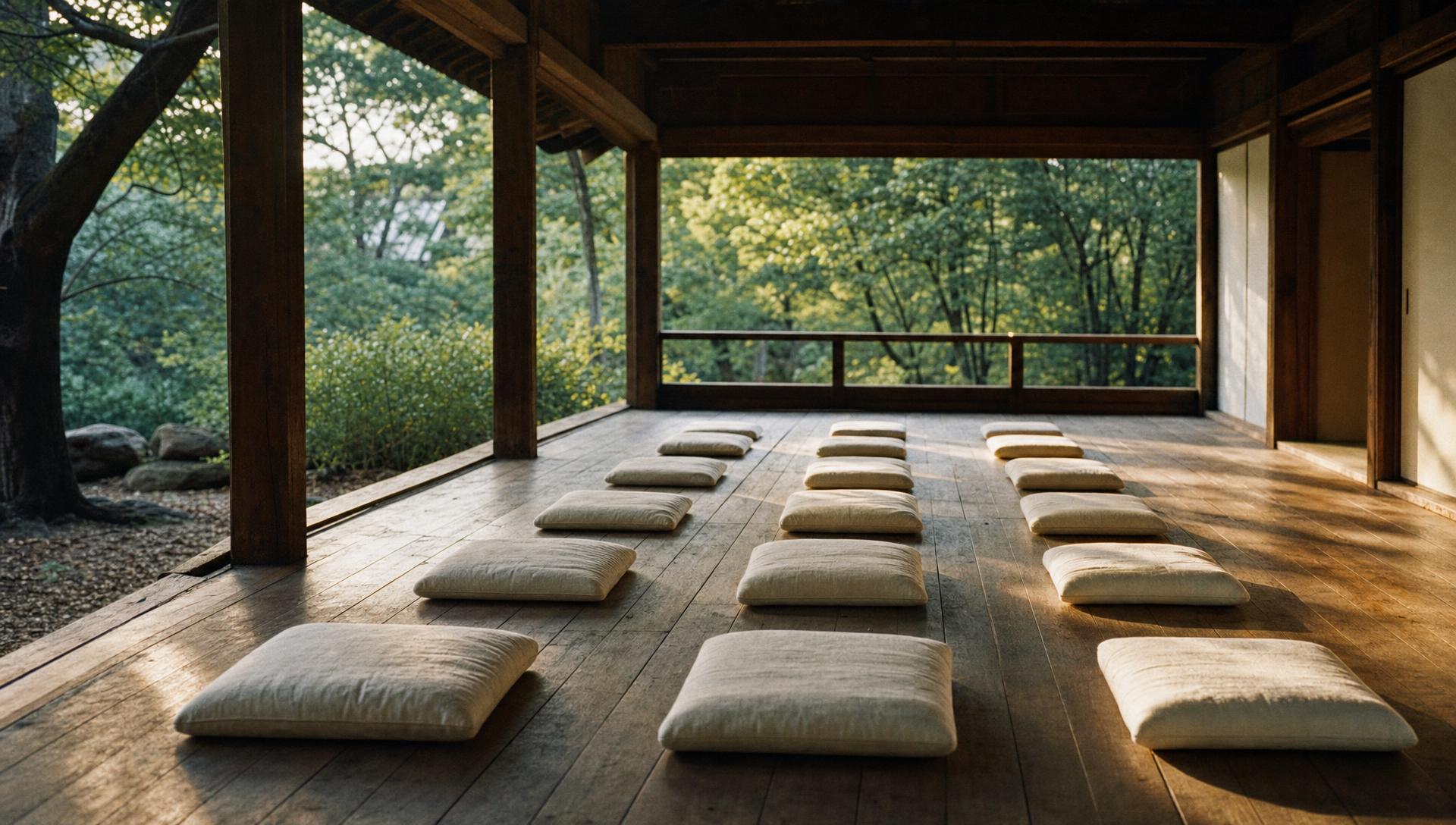
- Sit in a posture you can keep still: cross-legged on a cushion, kneeling, or on a chair with your feet flat. Keep the back upright but not stiff and rest the hands in the lap. The page on meditation posture shows each option.
- Set your intention. Many people begin by recalling the Buddha, the Dhamma and the Saṅgha, or by taking the five precepts, so that the mind sits down free of regret.
- Choose one object and stay with it. For most beginners the breath is simplest: feel it where it is clearest, and if the mind wanders a lot, count the breaths from one to ten and start again.
- When the mind wanders, notice where it went and come back without blame. Wandering off and coming back is the practice, not a failure. The page on the five hindrances explains the usual obstacles.
- Finish with a minute of loving-kindness for yourself and others, then get up slowly and carry some of the awareness into whatever you do next.
After a few weeks you can lengthen the sitting to twenty or thirty minutes and add a short period of walking before it. If you want to go on to insight practice, how to do vipassana gives a step-by-step plan for a week. Buddhist meditation is gentle work, but it can bring up old memories and strong emotions. Intensive practice is not a treatment for mental illness; anyone with a history of serious mental illness should talk to a doctor and an experienced teacher first.
Choosing a technique
The Visuddhimagga matches meditation subjects to temperament: loving-kindness for a person quick to anger, the contemplation of foulness for one easily caught by beauty, the recollections for a person of strong faith, and mindfulness of breathing for a mind that is dull or always thinking. Most people are a mix, so the simplest advice is this: start with the breath, add loving-kindness if you notice irritation or harshness toward yourself, and stay with one method long enough to learn it, a few months at least, rather than switching every week. Depth in one method teaches more than a taste of many.
Whatever you choose, the measure of Buddhist meditation is not how special a sitting feels but how you live afterwards: whether greed, anger and confusion grow a little lighter, and kindness and clarity a little stronger.
Based on: The two things that share in knowledge (AN 2.31) · Samādhibhāvanā Sutta (AN 4.41) · Mahānāma Sutta (AN 6.10) · Caṅkama Sutta (AN 5.29) · Satipaṭṭhāna Sutta (MN 10) · Visuddhimagga, by Buddhaghosa
Read next

Samatha vs vipassana: calm and insight compared
Samatha calms the mind and vipassana sees clearly: a point-by-point comparison from the suttas, and how to use the two together
The 40 Meditation Subjects (Kammatthana) of the Visuddhimagga
The 40 meditation subjects collected in the Visuddhimagga, in seven groups, with what each one is and what it is for
Metta Meditation: How to Practise Loving-Kindness Step by Step
Metta meditation from the Buddha's teaching: what loving-kindness is, how to practise it step by step, the phrases, and its eleven benefits