The 40 Meditation Subjects (Kammatthana) of the Visuddhimagga
The 40 meditation subjects collected in the Visuddhimagga, in seven groups, with what each one is and what it is for
The 40 meditation subjects are the forty objects for developing concentration that Buddhaghosa collected in the concentration section of the Visuddhimagga. Kammaṭṭhāna means a place of work for the mind. All forty are subjects for samatha, training the mind to become calm and collected, and they fall into seven groups. This page goes through every one of them, shows which suits which temperament and how deep each can take concentration, names the ones that suit everyone, and explains how they lead on to insight.
The 40 meditation subjects at a glance
The 40 meditation subjects fall into seven groups, ten, ten, ten, four, four, one and one, which add up to forty:
- Ten kasiṇas: devices to gaze at, such as earth, water, fire, air and colours.
- Ten kinds of foulness (asubha): a corpse in different stages.
- Ten recollections (anussati): things to call to mind again and again.
- Four divine abidings (brahmavihāra), also called the four boundless states.
- Four formless states (arūpa).
- One perception: the repulsiveness of food (āhāre paṭikūla-saññā).
- One analysis: defining the four elements (catudhātu-vavatthāna).
Ten kasinas
Kasiṇa means whole or complete. It is a device the meditator gazes at until its image stays in the mind even with the eyes closed, the learning sign (uggaha-nimitta), which then becomes a clear, bright image that can be extended, the counterpart sign (paṭibhāga-nimitta). The Visuddhimagga explains in detail how to make and gaze at an earth disc and uses it as the model for the others. The ten are:
- Pathavī-kasiṇa, earth: for example a smooth disc of clay.
- Āpo-kasiṇa, water: for example clear water in a bowl.
- Tejo-kasiṇa, fire: for example a flame seen through an opening.
- Vāyo-kasiṇa, air: wind seen moving leaves or felt on the body.
- Nīla-kasiṇa, blue or dark green.
- Pīta-kasiṇa, yellow.
- Lohita-kasiṇa, red.
- Odāta-kasiṇa, white.
- Āloka-kasiṇa, light: for example a patch of light falling through a gap.
- Paricchinnākāsa-kasiṇa, limited space: for example the space framed by a window.
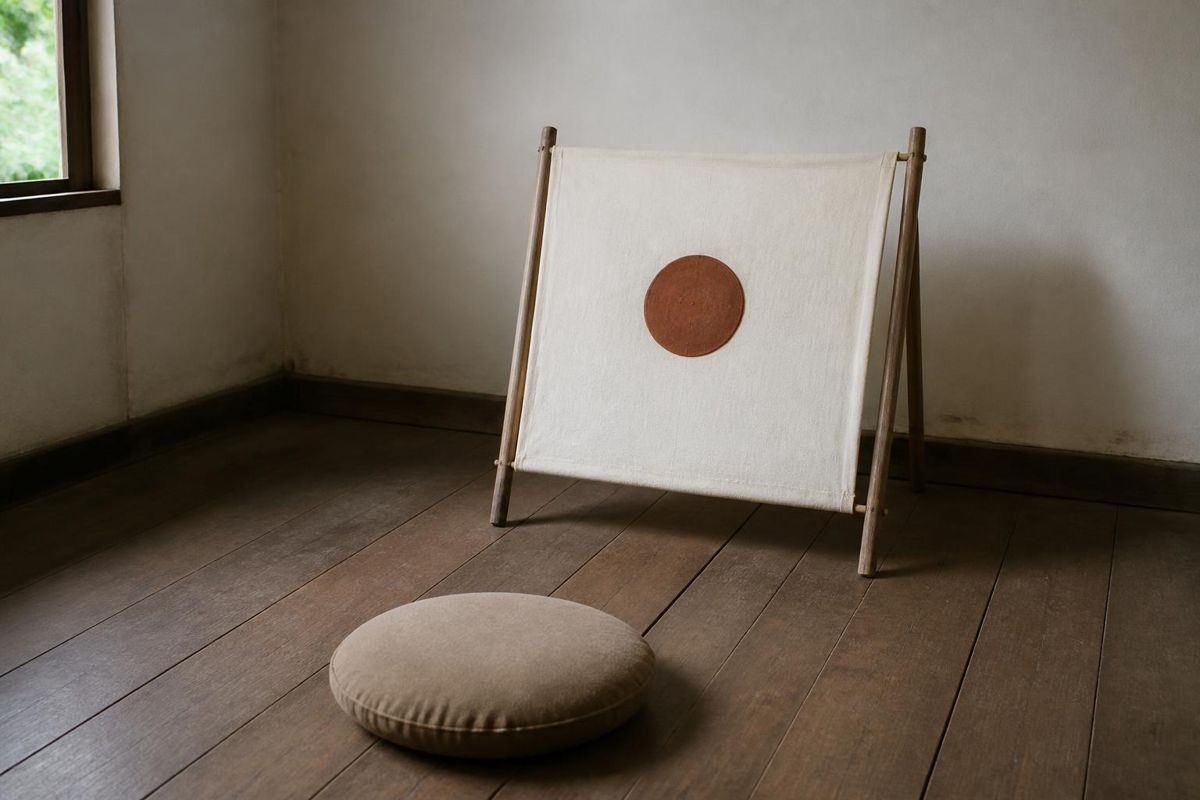
The suttas give a slightly different ten: in the Kasiṇa Sutta (AN 10.25), for example, the last two are space and consciousness, while the Visuddhimagga has light and limited space. This page follows the Visuddhimagga, which is where the list of 40 meditation subjects comes from.
Ten kinds of foulness (asubha)
Foulness meditation (asubha) is reflecting on a corpse in its different stages to weaken lust and attachment to the body. The aim is not to hate the body or to feel low, but to see the body as it really is. In the Satipaṭṭhāna Sutta the Buddha teaches comparing a corpse in a charnel ground with one's own body.
seyyathāpi passeyya sarīraṁ sivathikāya chaḍḍitaṁ
ekāhamataṁ vā dvīhamataṁ vā tīhamataṁ vā
uddhumātakaṁ vinīlakaṁ vipubbakajātaṁ.
So imameva kāyaṁ upasaṁharati:
ayampi kho kāyo evaṁdhammo evaṁbhāvī evaṁanatītoti.It is as if they were to see a corpse thrown away in a charnel ground, one, two or three days dead, bloated, livid and oozing. They compare it with their own body: 'This body too has the same nature; it will become like that and cannot escape it.'
MN 10
- Uddhumātaka, the bloated corpse.
- Vinīlaka, the livid, discoloured corpse.
- Vipubbaka, the festering corpse.
- Vicchiddaka, the corpse cut apart.
- Vikkhāyitaka, the gnawed corpse.
- Vikkhittaka, the scattered corpse.
- Hatavikkhittaka, the hacked and scattered corpse.
- Lohitaka, the bleeding corpse.
- Puḷuvaka, the worm-infested corpse.
- Aṭṭhika, the skeleton.
The Visuddhimagga says to learn foulness meditation from a teacher and practise it with care. In one discourse, after some monks became badly repelled by their own bodies through this practice, the Buddha taught them mindfulness of breathing as a peaceful and refined concentration (SN 54.9). If the reflection leaves you low or disgusted with yourself, switch to loving-kindness or the breath. Anyone with depression or a history of serious mental illness should talk to a doctor and an experienced teacher first.
Ten recollections
- Buddhānussati, recollecting the qualities of the Buddha.
- Dhammānussati, recollecting the qualities of the teaching.
- Saṅghānussati, recollecting the qualities of the community of noble disciples.
- Sīlānussati, recollecting one's own conduct, kept whole and unblemished.
- Cāgānussati, recollecting one's own generosity.
- Devatānussati, recollecting the faith, conduct, learning, generosity and wisdom that lead to rebirth among the gods, and seeing those same qualities in oneself.
- Maraṇassati, mindfulness of death: remembering that death is certain.
- Kāyagatāsati, mindfulness of the body: reviewing its thirty-two parts, such as head hair, body hair, nails, teeth and skin.
- Ānāpānassati, mindfulness of breathing; see the sixteen steps of breath meditation.
- Upasamānussati, recollecting peace: the qualities of nibbāna, the stilling of all defilements.
The first six appear together in the Mahānāma Sutta (AN 6.10). The Buddha tells Mahānāma that when a noble disciple recollects the Buddha, the teaching, the community, their conduct, their generosity or the qualities of the gods, the mind becomes straight, free of greed, hatred and delusion, and settles step by step into concentration.
Yasmiṁ, mahānāma, samaye ariyasāvako tathāgataṁ anussarati
nevassa tasmiṁ samaye rāgapariyuṭṭhitaṁ cittaṁ hoti,
na dosapariyuṭṭhitaṁ cittaṁ hoti, na mohapariyuṭṭhitaṁ cittaṁ hoti.
Pamuditassa pīti jāyati, pītimanassa kāyo passambhati,
passaddhakāyo sukhaṁ vediyati, sukhino cittaṁ samādhiyati.Mahānāma, at a time when a noble disciple recollects the Realised One, their mind is not overcome by greed, hatred or delusion. ... When they are glad, rapture arises; with a rapturous mind the body calms; with a calm body they feel happiness; and the happy mind becomes concentrated.
AN 6.10
Divine abidings, formless states and the last two
- Mettā, karuṇā, muditā, upekkhā: goodwill, compassion, gladness for others and equanimity, spread to all beings without limit. More on the page about the four divine abidings.
- Ākāsānañcāyatana, the dimension of infinite space.
- Viññāṇañcāyatana, the dimension of infinite consciousness.
- Ākiñcaññāyatana, the dimension of nothingness.
- Nevasaññānāsaññāyatana, the dimension of neither perception nor non-perception.
- Āhāre paṭikūla-saññā: reflecting on food from seeking it to eating and digesting it, to see its repulsive side and loosen attachment to taste.
- Catudhātu-vavatthāna: defining this body as just four elements: earth as hardness and softness, water as cohesion and flowing, fire as heat and cold, air as movement and support, just as the Satipaṭṭhāna Sutta teaches seeing that this body contains the earth, water, fire and air elements.
Matching the 40 meditation subjects to temperament
The Visuddhimagga sorts people into six temperaments (carita), the leanings that dominate a mind, and pairs the 40 meditation subjects with the temperament each one counters or supports:
- Greed temperament, easily caught by beauty: the ten kinds of foulness and mindfulness of the body, 11 in all.
- Hatred temperament, quick to irritation: the four divine abidings and the four colour kasiṇas, blue, yellow, red and white, 8 in all.
- Delusion temperament, prone to dullness, and the speculative temperament, prone to restless thinking: mindfulness of breathing.
- Faith temperament: the first six recollections, from the Buddha to the gods.
- Intelligent temperament: mindfulness of death, recollection of peace, the four elements, and the repulsiveness of food.
- Suitable for every temperament: the remaining six kasiṇas, earth, water, fire, air, light and space, and the four formless states.
This pairing is a guide, not a fixed rule; most people are a mix. That is why the Visuddhimagga leaves it to a teacher to observe the student and give a subject, which is the origin of the formal request for a meditation subject before practice. If you practise on your own at home, mindfulness of breathing and loving-kindness are a sound place to start for almost anyone.
How far each subject goes
Concentration has two main levels: access concentration (upacāra-samādhi), just short of absorption, and absorption (appanā-samādhi), which is jhāna. The Visuddhimagga sorts the 40 meditation subjects by the level each can reach, counting jhāna in four steps:
- Access only, 10 subjects: eight of the recollections (all but mindfulness of the body and of breathing), the repulsiveness of food, and the four elements.
- Up to the first jhāna, 11 subjects: the ten kinds of foulness and mindfulness of the body.
- Up to the third jhāna, 3 subjects: loving-kindness, compassion and gladness.
- All four jhānas, 11 subjects: the ten kasiṇas and mindfulness of breathing.
- The fourth jhāna only, 1 subject: equanimity, built on the first three divine abidings.
- The formless attainments, 4 subjects: the four formless states, built on the fourth jhāna reached through a kasiṇa.
Which of the 40 kammatthana suit everyone
The Visuddhimagga calls loving-kindness and mindfulness of death the subjects that are useful everywhere (sabbatthaka-kammaṭṭhāna), and notes that some teachers add the perception of foulness. Loving-kindness helps us live smoothly with others; mindfulness of death guards against carelessness and laziness; foulness weakens attachment to the body. Add recollection of the Buddha, which brings confidence and warmth, and you have the set known as the four protective meditations (caturārakkha).
These four can serve as a short preparation before your main practice: a moment recalling the Buddha's qualities, spreading loving-kindness to yourself and others, remembering that death can come at any time and so this time should not be wasted, and then your main subject. Together they take only a few minutes.
From the 40 meditation subjects to insight
All 40 meditation subjects belong to samatha. Their fruit is a calm, collected mind, the purification of mind, but calm alone is not yet wisdom. Someone who has gained concentration through any of the forty must turn to mind and matter, the body and mind actually arising: for example, on leaving jhāna, examining the jhāna factors as mind and the sitting body as matter, and seeing both as impermanent, unsatisfactory and not-self. How the two ways differ and support each other is explained on the page on samatha and vipassana.
Some subjects lead into insight more directly than others because their object is real rather than a constructed image: mindfulness of breathing and of the body, which watch the actual breath and body, and the four elements, which the Visuddhimagga names as the starting point for someone heading straight for insight. A kasiṇa disc or the sign that comes from it is a concept, something the mind constructs, so it cannot be the object of insight. The object of insight has to be mind and matter as they really occur, as the page on the objects of insight explains. In short, the 40 meditation subjects prepare the mind, and vipassana uses that prepared mind to see what is true.
Based on: Visuddhimagga, by Buddhaghosa · Satipaṭṭhāna Sutta (MN 10) · Mahānāma Sutta (AN 6.10) · Kasiṇa Sutta (AN 10.25) · Vesālī Sutta (SN 54.9)
Read next
Kammatthana: the meditation subjects of calm and insight
Kammatthana means a meditation subject: the two kinds, samatha and vipassana, the forty subjects, and how to choose

Samatha vs vipassana: calm and insight compared
Samatha calms the mind and vipassana sees clearly: a point-by-point comparison from the suttas, and how to use the two together

The Brahmaviharas: Loving-Kindness, Compassion, Joy, Equanimity
The brahmaviharas are loving-kindness, compassion, joy and equanimity: their meaning, everyday examples, how to practise them and their benefits in the suttas