
The five precepts are the five training rules of Buddhists: no killing, stealing, sexual misconduct, lying or intoxicants. Here with the request, the words of undertaking and the Pali with meaning, line by line
The five precepts are five training rules that Buddhists undertake so as not to harm themselves or others: not killing, not stealing, no sexual misconduct, not lying and no intoxicants. In Pali they are called pañcasīla, and in Thai also benchasin. None of them is a command from anyone; each is something you say yourself: 'I undertake this training rule.' Below is the whole ceremony for taking the five precepts, from the request and the homage to the Buddha, through the three refuges and the precepts themselves, to the monk's closing words, in Pali with the meaning.
What are the five precepts?
- Pāṇātipātā veramaṇī: refraining from killing and taking life.
- Adinnādānā veramaṇī: refraining from taking what is not given.
- Kāmesu micchācārā veramaṇī: refraining from sexual misconduct.
- Musāvādā veramaṇī: refraining from lying.
- Surāmerayamajjapamādaṭṭhānā veramaṇī: refraining from liquor, fermented drinks and intoxicants that cause heedlessness.
The Navakovada, the long-standing first-level Dhamma textbook, sets out the five precepts in its section on practice for householders. In its own words:
- Pāṇātipātā veramaṇī: refraining from causing a living being's life to fall away.
- Adinnādānā veramaṇī: refraining from taking things their owner has not given, in the manner of a thief.
- Kāmesu micchācārā veramaṇī: refraining from wrong conduct in sexual matters.
- Musāvādā veramaṇī: refraining from speaking falsely.
- Surāmerayamajjapamādaṭṭhānā veramaṇī: refraining from drinking intoxicants, that is, liquor and fermented drink, which are a basis for heedlessness.
The Navakovada closes the list by saying that householders should keep these five precepts always, every day and not only on holy days. Notice that every precept uses the word veramaṇī, 'refraining'. The precepts are about refraining from what causes harm, not a list of things to do; doing good actively is covered by other teachings, such as the ten wholesome ways of action.
Each of the five precepts in everyday life
- Precept 1, not killing, covers every kind of life, people and animals, down to small creatures such as mosquitoes and ants. In real life it invites you to look for ways that don't involve killing, such as using a net or shooing insects out instead of swatting them, and not to torment or hurt animals even when they do not die.
- Precept 2, not stealing, is not only theft. It includes cheating, embezzling, deliberately not returning what you borrowed, and taking shared or workplace property for personal use without permission.
- Precept 3, no sexual misconduct, means no sexual relations with another person's partner or with someone still in the care of parents or guardians, and never by force or deceit. In a relationship it means being faithful to each other.
- Precept 4, not lying, means not deliberately misleading others, whether by speech, in writing or by gesture. The Buddha taught more about speech than this, such as avoiding divisive, harsh and idle talk, but the one in the five precepts is lying.
- Precept 5, no intoxicants. If you ask what the fifth precept covers, the Pali names it: surā is distilled liquor, meraya fermented drinks such as beer and wine, majja what intoxicates, and pamādaṭṭhāna 'what causes heedlessness'. Teachers therefore count drugs that cloud the mind under this precept too. Medicine used to treat an illness on a doctor's advice is not taken to intoxicate, so it is not what this precept is aimed at.
When is a precept broken?
The commentaries, which explain the Tipiṭaka, set out what makes an act break a precept. These are called the factors of a precept: when all are present the precept is broken; when some are missing it is not broken, though it may be stained. The key point is that every precept involves intention, so stepping on an ant you did not see does not break the first precept.
- Precept 1 has five factors: a living being, knowing it is a living being, the intention to kill, the effort to kill, and the being dies from that effort.
- Precept 2 has five: property that belongs to someone else, knowing it belongs to someone else, the intention to steal, the effort, and taking it by that effort.
- Precept 3 has four: a person one should not be with, the intention to have sexual relations, the effort, and the act being carried through.
- Precept 4 has four: something untrue, the intention to deceive, the effort to say or show it, and the listener understanding it that way.
- Precept 5 has four: an intoxicant, the intention to drink it, the effort to drink, and it passing down the throat.
The lists are not there to find loopholes. They show that a precept depends on real intention and action, not on accident. Someone who sincerely keeps the precepts will sense for themselves when something comes too close to the line.
How to request and take the five precepts
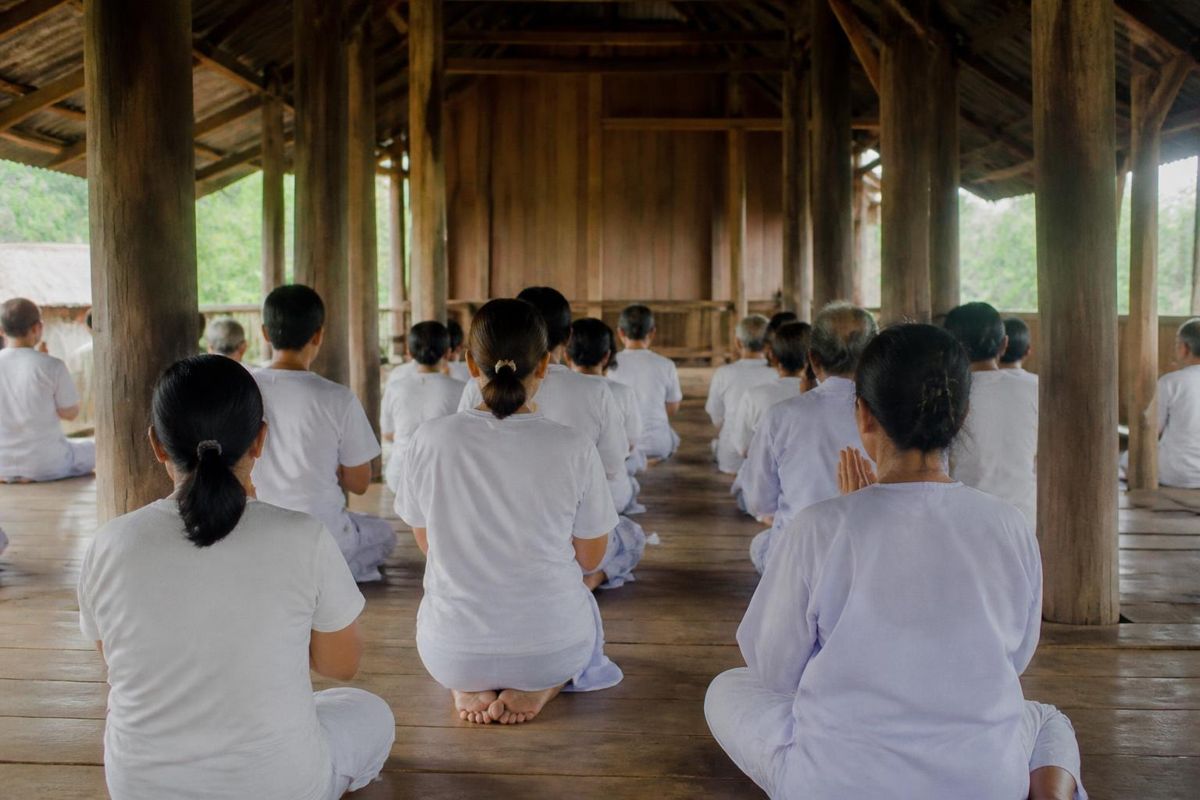
When you take the five precepts from a monk, at a temple, at a merit-making ceremony at home or before a Dhamma talk, the steps are as follows. Every line is in the chant below.
- With palms joined, everyone says the request three times: Mayaṁ bhante visuṁ visuṁ rakkhaṇatthāya tisaraṇena saha pañca sīlāni yācāma. When one person asks alone, say ahaṁ for mayaṁ and yācāmi for yācāma.
- The monk leads the homage, Namo tassa, three times, and you repeat each phrase after him.
- The monk leads the three refuges, and you repeat them through all three rounds. When he says Tisaraṇagamanaṁ niṭṭhitaṁ, you answer Āma bhante.
- The monk gives the precepts one at a time, and you repeat each one until all five are done.
- The monk says Imāni pañca sikkhāpadāni; you answer Āma bhante, and he closes with the verse Sīlena sugatiṁ yanti. Then you bow three times.
This request and others, such as the request for a Dhamma talk, are also on the page on requesting precepts and a sermon.
Taking the five precepts by yourself
You can take the precepts without a monk, because the precepts are your own commitment. The word samādiyāmi at the end of each line means 'I undertake': you are the one taking the training rule upon yourself. At home, leave out the request: bow, chant Namo tassa three times and the three refuges, then say the five precepts yourself. Many people recite the five precepts every morning as part of their daily chanting, and saying them each day keeps them in mind all day long.
The five precepts in Pali, word by word
Every precept has the same pattern: what you refrain from, then veramaṇī sikkhāpadaṁ samādiyāmi. Once you know these words, you understand all five precepts at once.
- Veramaṇī: refraining, abstaining.
- Sikkhāpadaṁ: a training rule, a step in training. The precepts are things to train in, not rules you must keep perfectly from the first day.
- Samādiyāmi: I undertake.
- Pāṇātipātā: from bringing life to an end; adinnādānā: from taking what is not given; kāmesu micchācārā: from wrong conduct in sensual matters; musāvādā: from false speech; surāmerayamajjapamādaṭṭhānā: from intoxicating drink that causes heedlessness.
Why keep the precepts?
In the Dīghajāṇu Sutta (AN 8.54) the Buddha counts accomplishment in ethics, which is refraining from these five, as one of four things that bring a householder welfare in lives to come, together with faith, generosity and wisdom. Ethics is also the first of the three trainings, ethics, mind and wisdom, because a mind not troubled by wrongs it has done settles easily. The sutta that teaches recollecting your own virtue says:
Puna caparaṁ, mahānāma, ariyasāvako attano sīlāni anussarati
akhaṇḍāni acchiddāni asabalāni akammāsāni
bhujissāni viññuppasatthāni aparāmaṭṭhāni samādhisaṁvattanikāni.Furthermore, Mahānāma, a noble disciple recollects their own virtue: unbroken, without holes, unblemished, unspotted, freeing, praised by the wise, not wrongly grasped, and leading to samādhi.
AN 6.10
The benefit you can see at once is freedom from worry. Someone who has not harmed, deceived or exploited anyone sleeps without anything weighing on the mind, and the people around them can trust them. Keeping the five precepts is a gift both to yourself and to others.
If you break a precept
The precepts are a training, so slipping is part of the training. When you realise you have broken one, admit it honestly to yourself without sinking into guilt, consider what led to it, and begin again by taking the precepts once more, from a monk or by yourself at home. If you want to train more deeply on some days, such as holy days, take the eight precepts, which add three more rules and change the third to no sexual activity at all.
The chant
Requesting the five precepts
Mayaṁ bhante visuṁ visuṁ rakkhaṇatthāya,
tisaraṇena saha pañca sīlāni yācāma.
Dutiyampi mayaṁ bhante visuṁ visuṁ rakkhaṇatthāya,
tisaraṇena saha pañca sīlāni yācāma.
Tatiyampi mayaṁ bhante visuṁ visuṁ rakkhaṇatthāya,
tisaraṇena saha pañca sīlāni yācāma.
Meaning
Venerable sir, we ask for the five precepts together with the three refuges, to keep each one separately. It is then said a second and a third time. When one person asks alone, say Ahaṁ for Mayaṁ and yācāmi for yācāma.
Homage to the Buddha
Namo tassa bhagavato arahato sammāsambuddhassa.
Say 3 timesMeaning
Homage to the Blessed One, the perfected one, the fully awakened Buddha.
The three refuges
Buddhaṁ saraṇaṁ gacchāmi,
Dhammaṁ saraṇaṁ gacchāmi,
Saṅghaṁ saraṇaṁ gacchāmi.
Dutiyampi buddhaṁ saraṇaṁ gacchāmi,
Dutiyampi dhammaṁ saraṇaṁ gacchāmi,
Dutiyampi saṅghaṁ saraṇaṁ gacchāmi.
Tatiyampi buddhaṁ saraṇaṁ gacchāmi,
Tatiyampi dhammaṁ saraṇaṁ gacchāmi,
Tatiyampi saṅghaṁ saraṇaṁ gacchāmi.
Meaning
I go to the Buddha for refuge, to the Dhamma for refuge, to the Saṅgha for refuge, then a second and a third time. At the end the monk says Tisaraṇagamanaṁ niṭṭhitaṁ ('the going for refuge is complete') and you answer Āma bhante ('Yes, venerable sir').
Precept 1: Not killing
Pāṇātipātā veramaṇī sikkhāpadaṁ samādiyāmi.
Meaning
I undertake the training to refrain from taking life. This means not deliberately killing any person or animal, whether by your own hand or by getting someone else to do it.
Precept 2: Not stealing
Adinnādānā veramaṇī sikkhāpadaṁ samādiyāmi.
Meaning
I undertake the training to refrain from taking what is not given. This covers stealing, cheating and taking anything without its owner's consent.
Precept 3: No sexual misconduct
Kāmesumicchācārā veramaṇī sikkhāpadaṁ samādiyāmi.
Meaning
I undertake the training to refrain from sexual misconduct. This means no sexual relations with someone you should not be with, such as another person's partner or someone still in the care of parents or guardians.
Precept 4: Not lying
Musāvādā veramaṇī sikkhāpadaṁ samādiyāmi.
Meaning
I undertake the training to refrain from false speech. This means not deliberately saying, or leading others to believe, something untrue.
Precept 5: No intoxicants
Surāmerayamajjapamādaṭṭhānā veramaṇī sikkhāpadaṁ samādiyāmi.
Meaning
I undertake the training to refrain from liquor and fermented drinks, intoxicants that cause carelessness. This covers spirits, beer, wine and other drugs that cloud the mind.
The monk's closing words
Imāni pañca sikkhāpadāni,
sīlena sugatiṁ yanti,
sīlena bhogasampadā,
sīlena nibbutiṁ yanti,
tasmā sīlaṁ visodhaye.
Meaning
These are the five training rules (you answer Āma bhante, 'Yes, venerable sir'). Through virtue people go to a good destiny, through virtue comes prosperity, through virtue they reach coolness and peace. So let virtue be made pure.
Machine translation from: The Three Refuges (KP 1) · The Ten Precepts (KP 2) · The request for precepts and the closing verse: traditional, author unknown · Navakovada (public domain) · Dīghajāṇu Sutta (AN 8.54) · Mahānāma Sutta (AN 6.10) · The Pali commentaries, on the factors of each precept
Read next
The Eight Precepts: What They Are, the Request and the Uposatha, with Meaning
The eight precepts are eight training rules kept on holy days or during a meditation retreat. Here with the Pali request and the meaning of each precept, how to take them at home, and leaving them
Requesting Precepts, a Sermon and Protective Chanting
The Pali words for asking monks for the precepts, for a sermon and for protective chanting

Buddhist Chanting at Home: Daily Chants with Meaning
Buddhist chanting for every day, in Pali with the meaning: the bow (Arahaṁ), the homage, the three refuges, the five precepts and the Itipi so, for morning, evening and holy days