How to do vipassana at home: a step-by-step guide
How to do vipassana at home, step by step: preparing, walking, sitting and noting, and a simple plan for your first week.
This is a step-by-step guide to how to do vipassana at home, without waiting until you can get to a temple or a course. It covers preparing a time and a place, setting an intention, walking, sitting, noting what happens in body and mind, handling pain, sleepiness and a wandering mind, and a simple plan for your first seven days. Everything here rests on the Satipaṭṭhāna Sutta, the Buddha's main teaching on mindfulness. If you are not yet sure how insight differs from other kinds of meditation, read what is vipassana first.
Preparing to practise vipassana at home: time, place and precepts
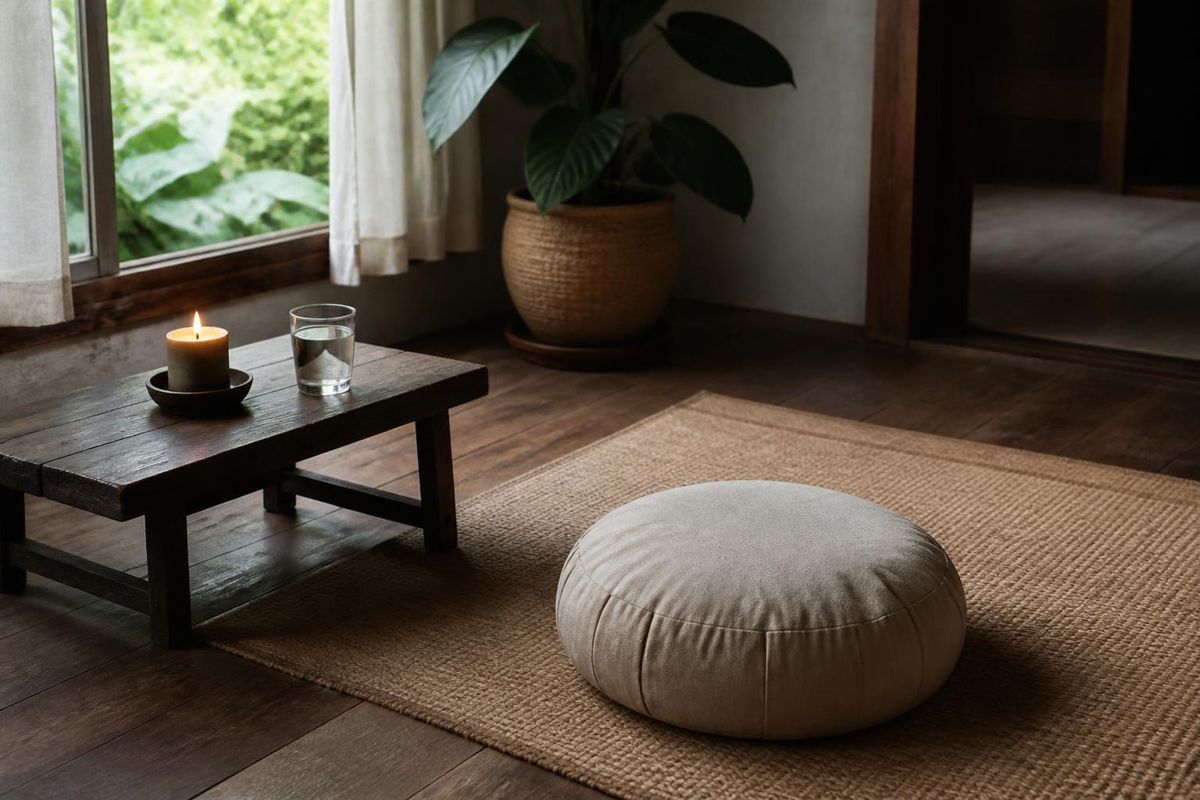
Choose a time you can really keep every day, such as just after waking or before bed, when the house is quiet and nobody needs you. Silence your phone or leave it in another room, and use a timer so you need not keep glancing at the clock. A small corner is enough: a steady place to sit and a straight path of five to ten steps for walking. If the path is shorter, simply turn more often. Wear loose clothes, and avoid starting straight after a heavy meal, when drowsiness comes easily.
Moral conduct (sīla) is the ground for calm and wisdom. Many people resolve to keep the five precepts on the days they practise. If you are practising for a whole day, such as a holy day or a day off, you might keep the eight precepts, which include no food after midday and no entertainment. A mind with nothing to worry about or regret settles more easily. No ceremony is needed; a sincere resolve is enough.
Setting your intention
Some people begin by bowing three times, chanting a short homage to the Buddha, Dhamma and Sangha, and reciting the traditional request for a meditation subject, which offers oneself to the Buddha and asks for a subject for realising nibbāna. This step is optional. You can say it in Pali, or set an intention in your own words, for example: 'For this period I will know body and mind as they really are, with patience and kindness toward myself.' What matters is knowing what you are about to do, and why.
Step 1: walk before you sit
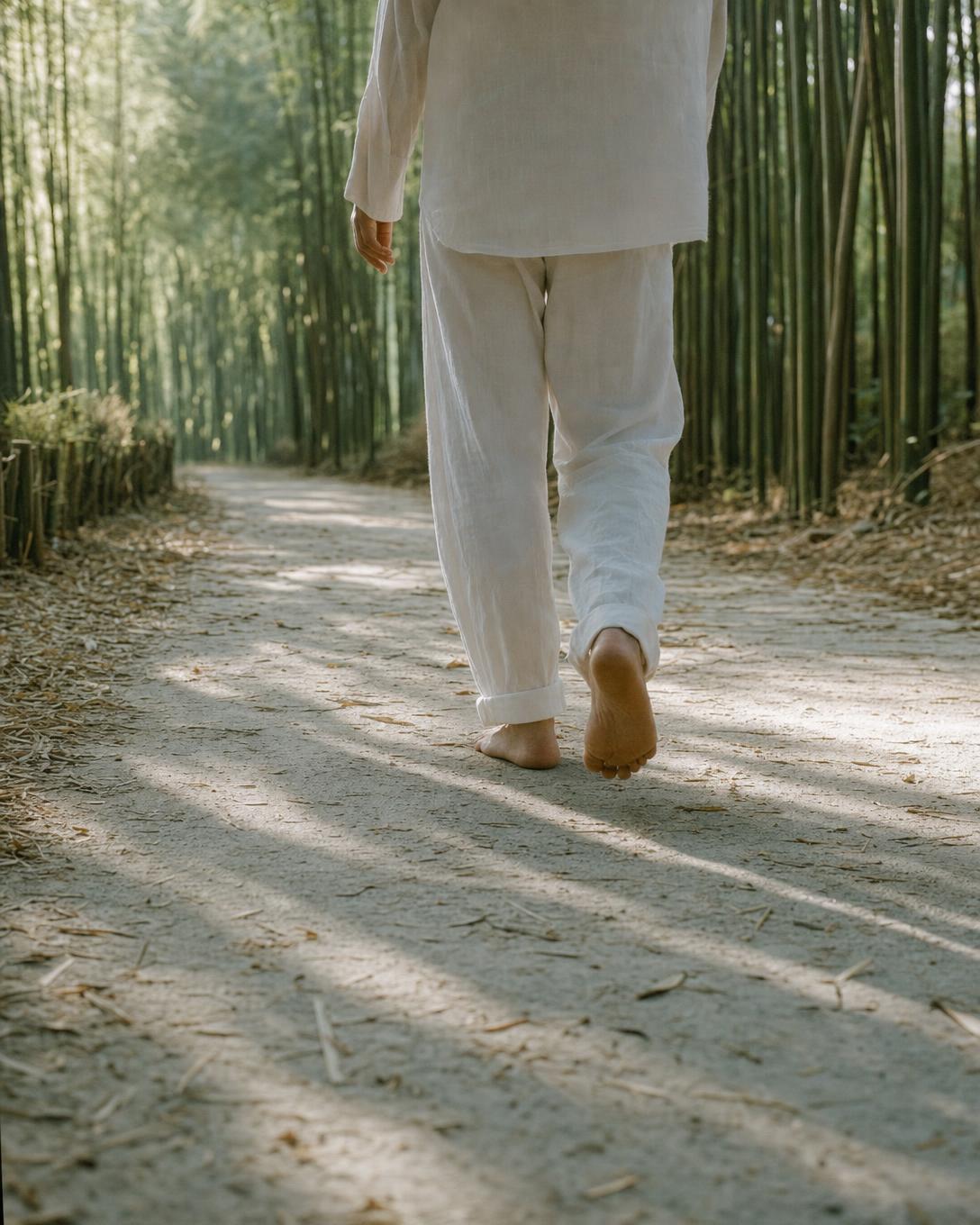
Many vipassana lineages begin each session with walking, then sit. Walking wakes the body up, eases drowsiness and carries unbroken mindfulness into the sitting. Stand at one end of your path and feel the weight on the soles of your feet. Then walk more slowly than usual, knowing the lifting, the moving forward and the placing of each foot. Keep your gaze on the floor about two metres ahead rather than looking around. At the end, stop, know that you are standing, know the turning, and walk back. People who use mental labels note 'right step, left step' with each foot. The details are on the walking meditation page.
Puna caparaṁ, bhikkhave, bhikkhu gacchanto vā gacchāmīti pajānāti,
ṭhito vā ṭhitomhīti pajānāti,
nisinno vā nisinnomhīti pajānāti,
sayāno vā sayānomhīti pajānāti.
Yathā yathā vā panassa kāyo paṇihito hoti, tathā tathā naṁ pajānāti.Furthermore, mendicants, when walking a mendicant knows: 'I am walking.' When standing they know: 'I am standing.' When sitting they know: 'I am sitting.' When lying down they know: 'I am lying down.' Whatever position the body is in, they know it just as it is.
MN 10
Step 2: sit and note, the core vipassana meditation technique
After walking, sit down without letting mindfulness lapse. Sit cross-legged on the floor or a cushion, or on a chair. Keep the body upright but not stiff, rest your hands in your lap, and close your eyes gently. In the Satipaṭṭhāna Sutta the Buddha describes sitting cross-legged, setting the body straight and bringing mindfulness to the fore. The point is an upright body and a mind in the present; if you cannot sit cross-legged for long, a chair is fine. Posture details are on the how to sit page.
Then rest attention on one main object. For beginners this is usually the rising and falling of the abdomen as you breathe, or the breath touching the nostrils. Do not control the breath; let it be natural and simply know the movement as it is. People who use labels note 'rising' as the belly swells and 'falling' as it sinks; this is explained on the noting meditation page. If you prefer the breath at the nose, see breath meditation in 16 steps.
Noting means knowing clearly what is happening right now. It is not thinking about the experience or analysing it, only knowing that it arises, changes and passes. If something else becomes clearer than the main object, such as a loud sound, pain or a thought, turn to it for a moment; when it fades, return to the abdomen or the breath. This is the heart of how to do vipassana meditation. The aim is not to hold the mind still on one thing all the time, but to keep knowing whatever appears, moment by moment, until you see for yourself that everything known is impermanent, beyond control and not a self.
What to note
The Satipaṭṭhāna Sutta groups what mindfulness can rest on into four areas. Whatever appears while you sit belongs to one of them.
- Body: rising and falling, movement, posture, hardness, softness, heat, cold, tension and vibration.
- Feelings: pleasant, painful or neutral, such as an aching knee, ease, or a flat tone that is neither.
- Mind: the state of the mind right now, such as angry, scattered, dull or calm.
- Dhammas: patterns the Buddha named, such as a hindrance blocking the mind, or seeing, hearing and the other sense contacts.
You do not need to sort each experience into its group while practising; knowing whatever is clearest is enough. The four groups simply show that everything in body and mind can be a basis for mindfulness, so nothing is truly a disturbance. Each group is explained on the four foundations of mindfulness page.
Pain, sleepiness and a wandering mind
- Pain: know it directly: where it is, how strong, how it changes. Often you will find it throbs, burns, spreads or moves. If you use labels, note 'pain'. If it becomes too much, first know the wish to move, then move slowly and mindfully. There is no need to push until you injure yourself.
- Sleepiness: know that you are sleepy. Open your eyes, straighten up, take a few deep breaths. If it stays, get up and walk, or wash your face, then sit again.
- Wandering: when you realise you have been thinking, know it, or note 'thinking', and return to the main object. No need to scold yourself; noticing that the mind wandered means mindfulness is working.
- Moods: boredom, irritation or fear can be noted in the same way. Know that it is there and watch how it changes.
Most of these are the five hindrances, which everyone who meditates meets. Meeting them does not mean you are doing it wrong. It is a chance to see states of mind arise and pass according to causes, which is exactly what insight is meant to see.
How to do vipassana correctly
Beginners often ask whether they are doing it right. Knowing how to do vipassana correctly is not a matter of calm, lights or special experiences. Look instead for these simple signs.
- You are knowing what is happening now, not what has passed or what you expect.
- You are knowing it evenly, neither pushing away what you dislike nor holding on to what you like.
- Your effort is balanced: not straining, not slack.
- You notice sooner and sooner when you have drifted.
- You begin to see that thoughts, feelings and pain come and go by themselves.
If unusual experiences come, such as lightness, lights or strong joy, note them like anything else. Do not take them as achievements or try to repeat them.
How long to sit
Start with 10 minutes of walking and 10 to 15 minutes of sitting, once or twice a day. Regularity matters more than length. As sitting becomes easier, add five minutes at a time until you can walk and sit for 30 to 45 minutes each. On an intensive retreat people alternate walking and sitting all day, but at home there is no need for that. Two short sessions every day do more than one long session a month.
A first-week plan: vipassana for beginners
- Day 1: walk 10 minutes, sit 10 minutes. Know only the rising and falling, or the breath. When the mind wanders, come back.
- Day 2: same times. Add noting thoughts: when you see you are thinking, note it and return.
- Day 3: walk 15, sit 15. Add hearing and aches.
- Day 4: same times. When walking, divide each step into two parts: lifting and placing.
- Day 5: walk 20, sit 20. Add pleasant, painful and neutral feeling.
- Day 6: same times. During the day, know small movements: standing up, sitting down, reaching, drinking.
- Day 7: walk and sit 20 to 30 minutes each. Look back on what you noticed this week and set your times for the next.
This plan is only an example, not a fixed formula. On a busy day, five minutes is still far better than nothing.
Taking it into daily life
Learning how to do vipassana is not only about the cushion. In the Satipaṭṭhāna Sutta the Buddha speaks of full awareness in every activity, from walking to speaking and keeping silent. Choose one activity a day, such as brushing your teeth, washing the dishes or walking to the bus, and know the movements from start to finish. When anger or worry comes up during the day, pause for one breath, feel how it sits in the body, and only then respond.
Puna caparaṁ, bhikkhave, bhikkhu abhikkante paṭikkante sampajānakārī hoti,
ālokite vilokite sampajānakārī hoti,
samiñjite pasārite sampajānakārī hoti,
saṅghāṭipattacīvaradhāraṇe sampajānakārī hoti,
asite pīte khāyite sāyite sampajānakārī hoti,
uccārapassāvakamme sampajānakārī hoti,
gate ṭhite nisinne sutte jāgarite bhāsite tuṇhībhāve sampajānakārī hoti.Furthermore, mendicants, a mendicant acts with full awareness when going forward and coming back, when looking ahead and looking aside, when bending and stretching the limbs, when wearing the robes and carrying the bowl, when eating, drinking, chewing and tasting, when urinating and defecating, and when walking, standing, sitting, falling asleep, waking, speaking and keeping silent.
MN 10
A note on safety
Short daily sessions suit most people, but intensive practice is not a treatment for mental illness: if you have a history of serious mental illness, talk to a doctor and an experienced teacher first. If strong fear or distress arises while practising, open your eyes, rest, and come back when you are ready. Once you practise regularly at home and want to go further, read about what a vipassana retreat is like.
Based on: Satipaṭṭhāna Sutta (MN 10)
Read next
Noting meditation: rising and falling, step by step
Noting meditation with the rising and falling of the abdomen: how to note, what labels to use, walking with noting, and common mistakes.
Walking meditation: how to do it, step by step
Walking meditation step by step: the path, pace, eyes and hands, noting each step in one to six parts, turning, and the five benefits the Buddha named.
Vipassana retreat: what to expect from a 7- or 10-day course
What a vipassana retreat is like: where the seven days come from, the usual formats, a typical day, the rules, what to bring and the hard parts.