Noting meditation: rising and falling, step by step
Noting meditation with the rising and falling of the abdomen: how to note, what labels to use, walking with noting, and common mistakes.
Noting meditation is a way of practising insight that uses the rising and falling of the abdomen as its main object. You know each movement as it happens and name it with a short mental label: 'rising' as the belly swells, 'falling' as it sinks. In Thai the method is widely known by its labels, phong-no and yup-no, where the soft ending 'no' simply stretches the label to cover the whole movement; it is not a charm or a sacred word. This page explains how to practise noting meditation from the first step, how to note whatever else comes up, how to walk with labels, the mistakes people often make, and when to drop the labels.
Where noting meditation comes from
The method is rooted in the Satipaṭṭhāna Sutta's teaching of knowing body and mind as they are, with mindfulness and clear awareness (sampajañña), especially the section on the body, which asks the meditator to know every posture and movement. Noting the abdomen with short labels is an approach popularised in the twentieth century by Burmese teachers in the Mahasi line. The suttas do not mention the abdomen as such, but teachers of this line explain that the tightness, pressure and motion felt there are the marks of the air element (vāyodhātu), one of the four elements the sutta asks us to examine. Mahasi noting is, in that sense, body contemplation applied to the movement nearest at hand.
Puna caparaṁ, bhikkhave, bhikkhu imameva kāyaṁ yathāṭhitaṁ yathāpaṇihitaṁ dhātuso paccavekkhati:
atthi imasmiṁ kāye pathavīdhātu āpodhātu tejodhātu vāyodhātūti.Furthermore, mendicants, a mendicant examines this very body, however it is placed or positioned, by way of the elements: 'In this body there is the earth element, the water element, the fire element and the air element.'
MN 10
Why the abdomen?
The abdomen moves clearly the whole time you breathe. Nothing needs to be forced or imagined, so beginners find it easily. And because the rising and falling keeps changing, never twice the same, it suits insight practice, which is about seeing impermanence. That is why noting meditation usually starts here. Practice aimed only at calm tends to prefer a steady, unchanging object; the difference is explained under samatha and vipassana. If you cannot feel the abdomen clearly, rest a hand on it for a while at first, or practise lying on your back until the movement is clear, then return to sitting.

How to note rising and falling, step by step
- Sit in a steady posture, back upright, eyes closed, breathing normally. Do not breathe deeper or harder than usual.
- Rest attention on the abdomen where the movement is clearest, usually just above or below the navel. Do not picture it; just feel it.
- As the belly rises, know the rising from beginning to end and note 'rising'.
- As it falls, know the falling from beginning to end and note 'falling'.
- If there is a gap between breaths with nothing to note, know the sitting posture and a point where the body touches the floor, noting 'sitting, touching', then return to the abdomen at the next rising.
- Continue until the time is up. Each time the mind runs off, once you notice, note what took it away and come back to the abdomen.
Labels and timing
Labels only help aim the mind at the experience; they are not the practice itself. Three points matter. First, the label must match the moment: not before, not after. Do not note 'rising' before the belly rises, or after the rising has finished. Second, labels should be short, plain words for what is happening; there is no need to hunt for the perfect word, and if unsure you can simply note 'knowing'. Third, attention stays on the experience, not the word. A label is like a finger pointing at something; what you want to know is the thing, not the finger. Keep the inner voice soft, with most of your attention on the actual sensation. In noting meditation the word serves the knowing, never the other way round.
Secondary objects: sounds, thoughts and feelings
Noting meditation does not mean shutting other things out. When something is clearer than the abdomen, turn to it and note it; when it fades, return to the abdomen. Common labels include:
- 'Hearing': when a sound pulls attention, know just the hearing, without following what it is or who made it.
- 'Thinking': when you notice you are thinking, note it two or three times and come back. No need to finish the thought.
- 'Pain', 'aching', 'itching': know the sensation where it is and watch how it grows, fades or changes shape.
- 'Angry', 'bored', 'happy': know the state of mind as it is, without explaining or judging it.
- 'Wanting to move': know the intention before you shift, then note each part of the movement that follows.
- 'Seeing': when the eyes open or an image appears in the mind, know just the seeing.
Noting meditation while walking
In this approach people usually walk before they sit, noting in the same way. Stand still at one end of the path and note 'standing', then walk slowly, one step at a time. Beginners start with the first stage and add detail only when mindfulness is steady.
- Stage one: 'right step, left step', noting each foot as it moves.
- Stage two: 'lifting, placing', separating the lift from the placing.
- Stage three: 'lifting, moving, placing', adding the forward movement in the middle.
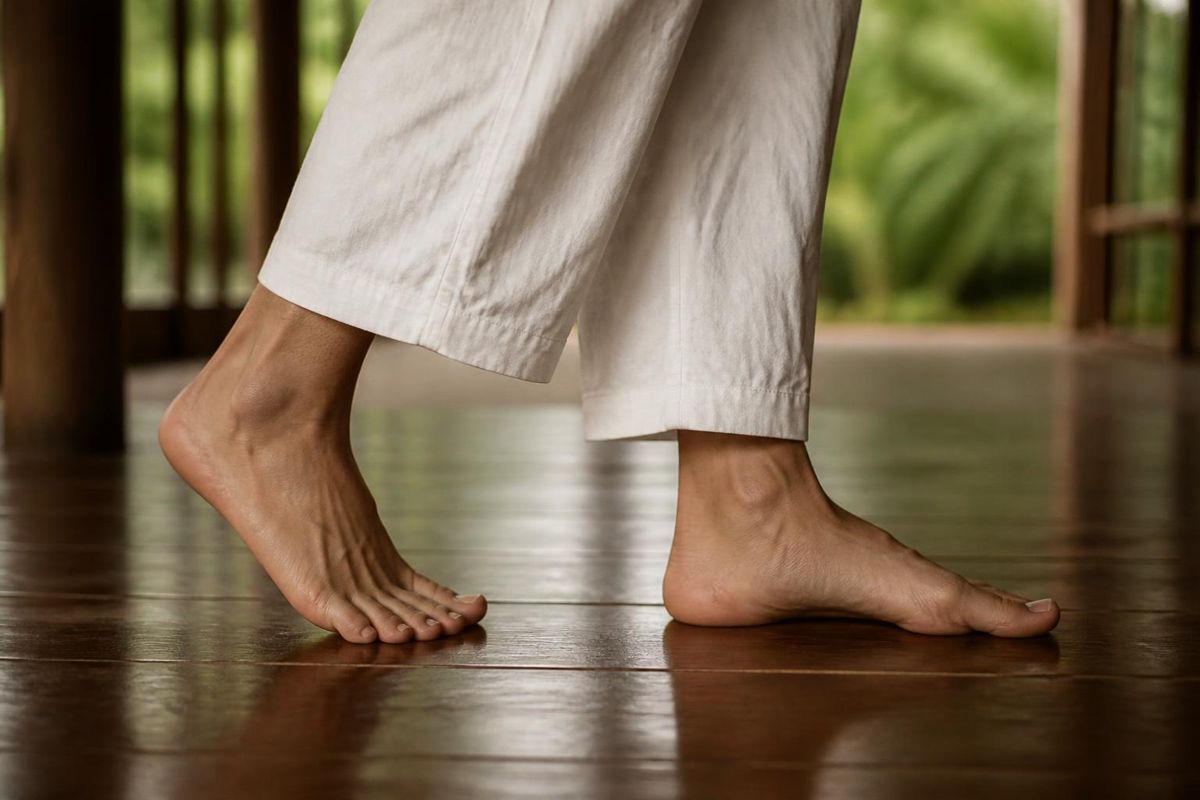
At the end of the path note 'stopping', then turn slowly, noting 'turning'. Do not hurry to add stages; walking with one stage and unbroken awareness is better than many stages with a wandering mind. The same principle applies to the small movements of the day, such as standing up, sitting down, reaching, picking up, eating and drinking: know each movement as it happens. Walking practice is covered in more detail on the walking meditation page.
Common mistakes
- Forcing the breath: breathing hard or deep to make the movement clearer only tires and tightens you. Let the breath be natural; if the movement is small, know that it is small.
- Labels without awareness: repeating 'rising, falling' like a recitation while the mind is not actually feeling the movement. That is reciting, not noting meditation.
- Following the thought while noting it: noting 'thinking' but carrying on with the story. Note it, really let the story go, and come back.
- Staring too hard: focusing so tightly that the head aches or the chest goes tight. Good mindfulness is light and continuous, not squeezed.
- Chasing special experiences: lights, lightness or joy are simply more things to note. Held on to, they become the imperfections of insight.
- Judging yourself: deciding you cannot do it because the mind is busy. A busy mind that is noticed is practice working.
When to drop the labels
Labels help a great deal at first because they keep the mind from slipping away, but they are not meant forever. When mindfulness is continuous and experiences arise and vanish faster than you can name them, simply know without words. If the labels become a loud inner voice that gets in the way of knowing, let them go. In times of heavy grief, repeated labelling can turn into pushing the feeling away; then know the feeling gently, breathe slowly, or practise the four divine abidings for a while. If labels never suit you, that is not a failure: satipaṭṭhāna is about knowing clearly, not about talking to yourself. Anyone with a history of serious mental illness should talk to a doctor and an experienced teacher before intensive practice.
Noting in daily life
Noting meditation is not only for formal sitting. Before a meeting, know three breaths of rising and falling. Waiting in a queue, know standing and the weight on your feet. In bed, lie on your back and know the rising and falling until you fall asleep. When anger or worry comes up, note it briefly, 'angry' or 'worried', before you speak or act. Short moments like these keep mindfulness going between sessions and make the next session easier. For a full home routine, see how to do vipassana at home.
Based on: Satipaṭṭhāna Sutta (MN 10)
Read next

How to do vipassana at home: a step-by-step guide
How to do vipassana at home, step by step: preparing, walking, sitting and noting, and a simple plan for your first week.
Walking meditation: how to do it, step by step
Walking meditation step by step: the path, pace, eyes and hands, noting each step in one to six parts, turning, and the five benefits the Buddha named.
Four foundations of mindfulness (satipatthana) with examples
The four foundations of mindfulness: every practice in the Satipatthana Sutta, the refrain that runs through them, and everyday examples of each.