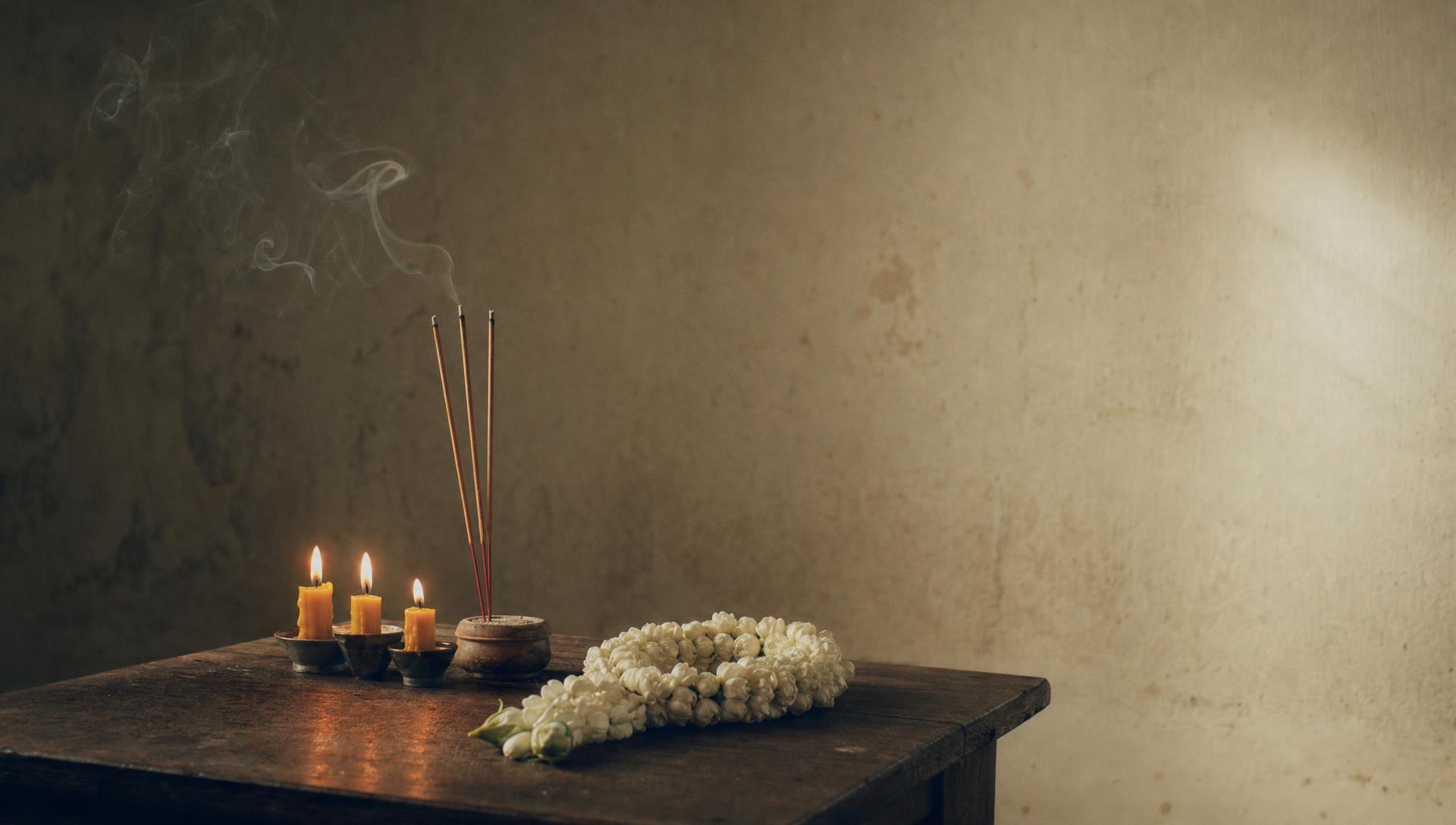
Buddham saranam gacchami: the Pali chant of the three refuges from the Khuddakapāṭha, with the meaning of each line and what going for refuge means
Buddham saranam gacchami, 'I go to the Buddha for refuge', is the first line of the three refuges (tisaraṇa), the short Pali chant by which Buddhists take the Buddha, the Dhamma and the Saṅgha as their refuge. It comes from the Khuddakapāṭha, the first book of the Minor Collection of the Tipitaka, and it is recited before taking the precepts, in daily chanting and at almost every Buddhist ceremony. This page gives the chant in Pali with the meaning of each line, and explains what going for refuge means.
What are the three refuges?
Tisaraṇa means 'the three refuges'; the Thai name, trai-sarana-khom, means 'going to the three refuges'. A refuge (saraṇa) is a shelter, a place of safety, and gacchāmi in the chant means 'I go'. The three are also called the Triple Gem (ratanattaya), the three precious things:
- The Buddha: the teacher who awakened by his own effort and showed the way out of suffering, the living proof that a human being can awaken.
- The Dhamma: what he taught and the truth it points to, both the path and its goal, nibbāna.
- The Saṅgha: the community of disciples who have practised the teaching and seen its truth for themselves, and in a wider sense the monks and nuns who have kept the teaching alive to this day.
The qualities of each are spelled out in the Itipi so chant, which many people recite after the three refuges.
What going for refuge means
Going for refuge is not joining a club or handing your life over to someone else. It is a decision of the heart: to take the Buddha as your teacher, the Dhamma as your guide and the Saṅgha as your example and companions on the way. In the suttas, people moved by a teaching declare it in their own words. At the end of the Kalama Sutta, for example, the Kālāmas say: 'We go for refuge to the Blessed One, to the Dhamma and to the Saṅgha of monks. From this day on, may the Blessed One remember us as lay followers who have gone for refuge for life.'
The Dhammapada makes clear what kind of shelter this is. Many people, driven by fear, go for refuge to mountains, forests, parks, trees and shrines, but that refuge is not secure and does not free them from suffering. The secure refuge is the Buddha, the Dhamma and the Saṅgha, for one who sees the four noble truths with right wisdom. So the three refuges are not a charm against danger. They protect by changing how we see and how we live. The verses are given at the end of the chant below.
Relying on the Triple Gem does not mean giving up responsibility. In the last months of his life the Buddha told Ānanda to live with himself as his island and his refuge, with the Dhamma as his island and his refuge, and no other refuge. The Buddha shows the way; each person has to walk it.
When the three refuges are recited
- Before taking the precepts. After the request for the precepts and the homage to the Buddha, a monk leads the refuges line by line and everyone repeats them; then the five precepts or the eight follow.
- In daily chanting, at home or at a temple, after the homage to the Buddha; see the daily chants.
- At ceremonies and holy days, such as merit-making, blessings, funerals and Vesak.
- At a novice's ordination, where going for the three refuges is the heart of the ceremony.
- Alone, at any time: before meditation, before sleep, or whenever you want to remember what matters.
How to recite Buddham saranam gacchami
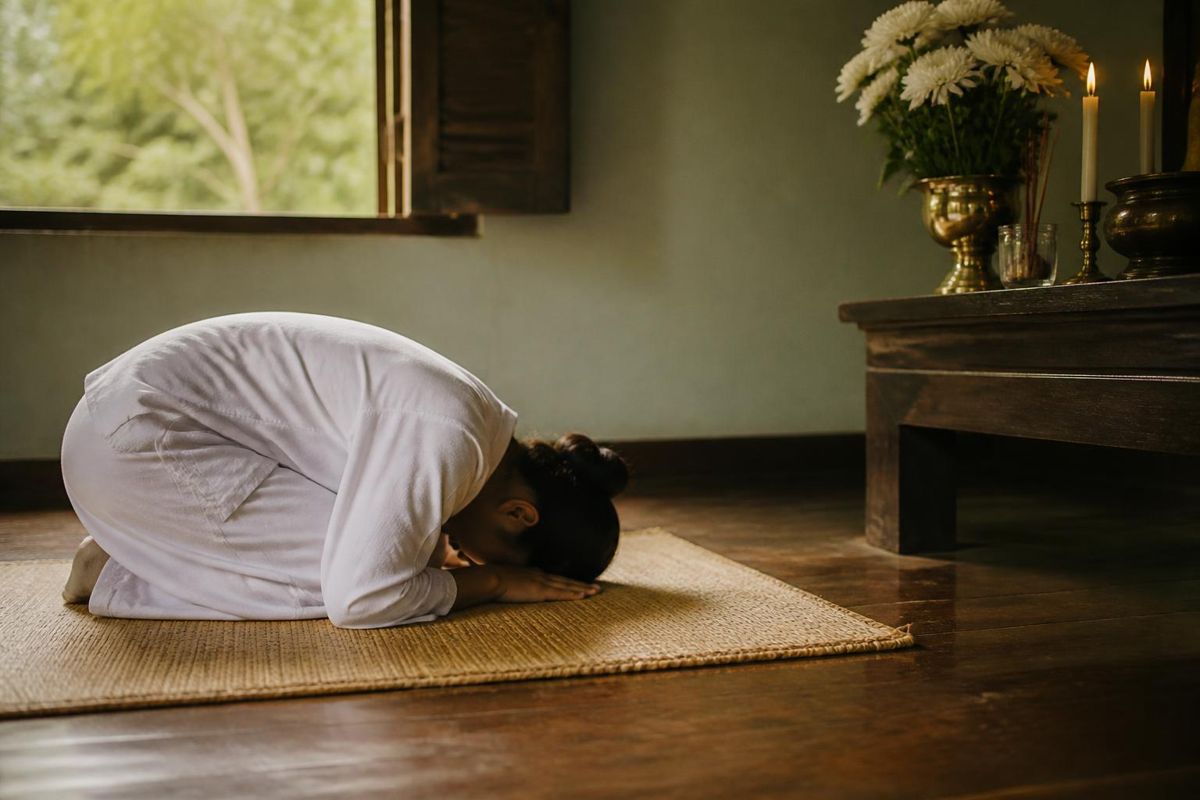
Sit or kneel before a Buddha image if you have one, or anywhere quiet. Many people first bow three times, with forehead, forearms and palms touching the floor, once each for the Buddha, the Dhamma and the Saṅgha. Then say the homage to the Buddha three times, followed by Buddham saranam gacchami and the other refuges, all three sets. Say the words slowly, with their meaning in mind; it is better to recite once with attention than many times without it.
On pronunciation: Buddham saranam gacchami is said roughly bud-dhang sa-ra-nang gach-chah-mee. The ṁ at the end of a word is a soft nasal, heard as 'ng' in Thai chanting, and double consonants are held for a moment. In Thai reading letters the line is พุทธัง สะระณัง คัจฉามิ.
The chant
Namo tassa: homage to the Buddha
Namo tassa bhagavato arahato sammāsambuddhassa.
Say 3 timesMeaning
Homage to him, the Blessed One, the perfected one, the fully awakened Buddha. It is said three times before the refuges, and it also opens the Khuddakapāṭha.
Buddham saranam gacchami: refuge in the Buddha
Buddhaṁ saraṇaṁ gacchāmi,
Meaning
Buddham saranam gacchami: I go to the Buddha for refuge. Buddhaṁ is the Buddha, saraṇaṁ a refuge, gacchāmi 'I go'. It means: I take the Buddha as my teacher, trusting that awakening as he awakened is possible.
Dhammam saranam gacchami: refuge in the Dhamma
Dhammaṁ saraṇaṁ gacchāmi,
Meaning
I go to the Dhamma for refuge. It means: I will let the teaching guide me, and practise it until I see its results for myself.
Sangham saranam gacchami: refuge in the Sangha
Saṅghaṁ saraṇaṁ gacchāmi.
Meaning
I go to the Saṅgha for refuge. It means: I take those who practise well as my example, and I am grateful to those who have kept the teaching alive for us.
Dutiyampi: the three refuges a second time
Dutiyampi buddhaṁ saraṇaṁ gacchāmi,
Dutiyampi dhammaṁ saraṇaṁ gacchāmi,
Dutiyampi saṅghaṁ saraṇaṁ gacchāmi.
Meaning
For the second time I go to the Buddha for refuge; for the second time, to the Dhamma; for the second time, to the Saṅgha. Dutiyampi means 'for the second time'.
Tatiyampi: the third time
Tatiyampi buddhaṁ saraṇaṁ gacchāmi,
Tatiyampi dhammaṁ saraṇaṁ gacchāmi,
Tatiyampi saṅghaṁ saraṇaṁ gacchāmi.
Meaning
For the third time I go to the Buddha for refuge; for the third time, to the Dhamma; for the third time, to the Saṅgha. Saying it three times is the traditional way to make a declaration firm and unmistakable, not words that slipped out once.
Closing words when a monk leads
Tisaraṇagamanaṁ niṭṭhitaṁ.
Āma bhante.
Meaning
The monk says: 'The going for the three refuges is complete.' You answer Āma bhante, 'Yes, venerable sir'. These words are not in the Khuddakapāṭha; they are the traditional wording of the precept ceremony.
The secure refuge: Dhammapada 188–192
Bahuṁ ve saraṇaṁ yanti,
pabbatāni vanāni ca;
Ārāmarukkhacetyāni,
manussā bhayatajjitā.
Netaṁ kho saraṇaṁ khemaṁ,
netaṁ saraṇamuttamaṁ;
Netaṁ saraṇamāgamma,
sabbadukkhā pamuccati.
Yo ca buddhañca dhammañca,
saṅghañca saraṇaṁ gato;
Cattāri ariyasaccāni,
sammappaññāya passati.
Dukkhaṁ dukkhasamuppādaṁ,
dukkhassa ca atikkamaṁ;
Ariyaṁ caṭṭhaṅgikaṁ maggaṁ,
dukkhūpasamagāminaṁ.
Etaṁ kho saraṇaṁ khemaṁ,
etaṁ saraṇamuttamaṁ;
Etaṁ saraṇamāgamma,
sabbadukkhā pamuccati.
Meaning
Many people, driven by fear, go for refuge to mountains and forests, to parks, trees and shrines. That is not a secure refuge, not the highest refuge; going to that refuge, one is not freed from all suffering. But whoever has gone for refuge to the Buddha, the Dhamma and the Saṅgha sees with right wisdom the four noble truths: suffering, the arising of suffering, the going beyond suffering, and the noble eightfold path that leads to the stilling of suffering. That is the secure refuge, that is the highest refuge; going to that refuge, one is freed from all suffering. These verses are for reflection; they are not part of the refuge ceremony.
Machine translation from: Saraṇattaya, the Three Refuges, Khuddakapāṭha (KP 1) · Dhammapada, Chapter on the Buddha (Dhp 179–196) · Kesamutti Sutta (to the Kālāmas) (AN 3.65) · Mahāparinibbāna Sutta (DN 16) · Closing words of the refuge ceremony, traditional wording, author unknown
Read next

The Five Precepts: What They Are and How to Take Them
The five precepts are the five training rules of Buddhists: no killing, stealing, sexual misconduct, lying or intoxicants. Here with the request, the words of undertaking and the Pali with meaning, line by line
Buddhist Chanting at Home: Daily Chants with Meaning
Buddhist chanting for every day, in Pali with the meaning: the bow (Arahaṁ), the homage, the three refuges, the five precepts and the Itipi so, for morning, evening and holy days
The Itipiso Chant with Translation: the Qualities of the Buddha, Dhamma and Saṅgha
The Itipiso chant in Pali with reading and translation: the Buddha's 9 qualities, the Dhamma's 6 and the Saṅgha's 9, its source in the suttas, and chanting it 3, 9 or 108 times