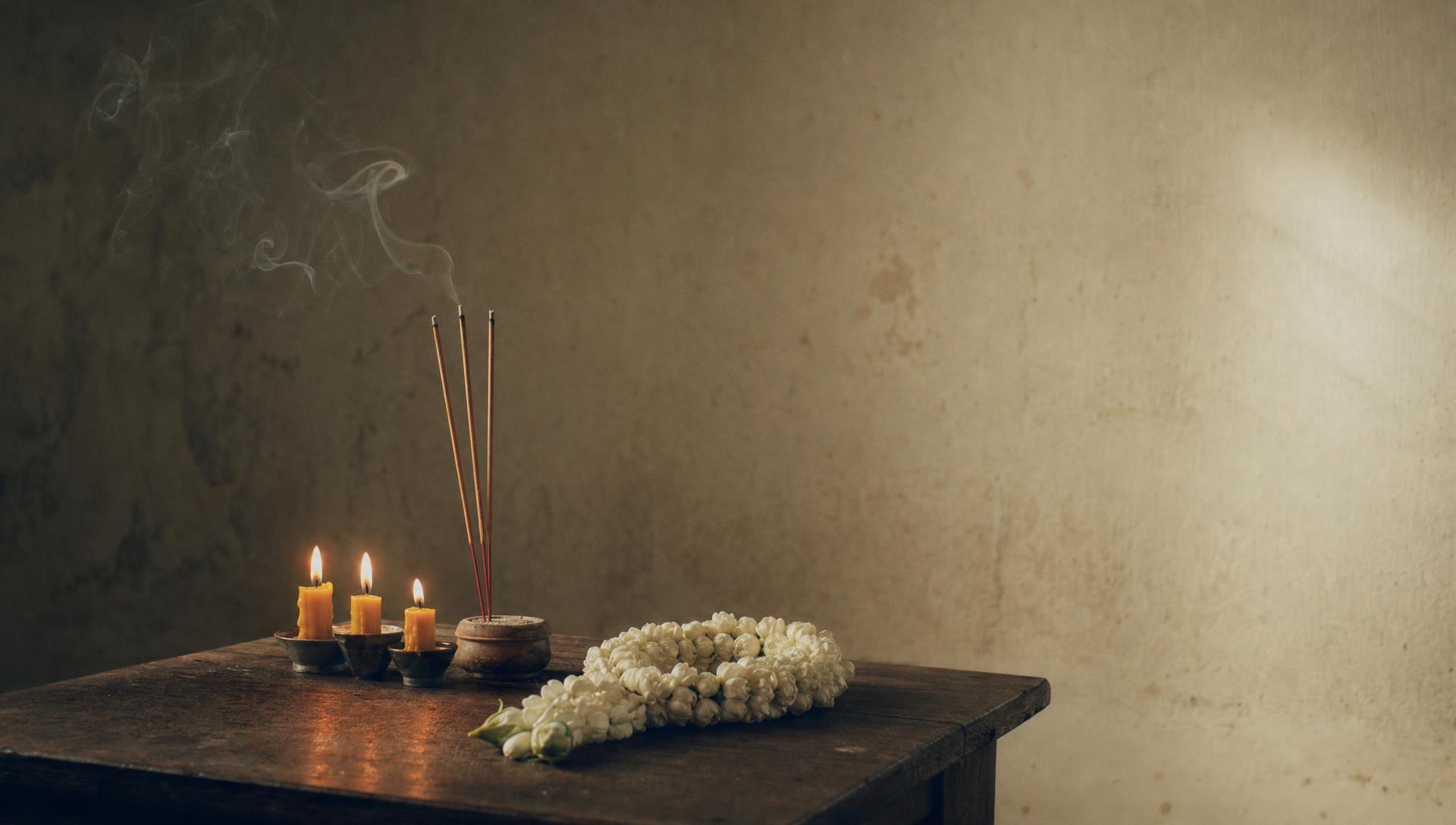
Vesak is the full moon day that remembers the Buddha's birth, awakening and final passing: what it means, how it is kept, and a reflection
Vesak is the most important day of the year in Theravada Buddhism. On the full moon of the sixth lunar month, Buddhists remember three events in the life of the Buddha: his birth, his awakening and his final passing, which by tradition all took place on this same full moon. The name Vesak, also spelled Wesak, comes from Vesākha, the Pali name of the month; in Thai the day is called Visakha Bucha. This page explains what Vesak is, when it falls, what it remembers, how Vesak is observed, and how to keep the day at home.
What is Vesak?
The Thai name Visakha Bucha is short for the Pali Visākhapuṇṇamī-pūjā, 'honouring on the full moon of Visākha'. Vesak is not a festival of a god, and it is not a day for asking for luck. It is a day to remember a human teacher who found the end of suffering, to be grateful for what he taught, and to honour him in the way he himself asked for: by practice.
Vesak is one of the three main holy days of the Theravada year. Māgha Pūjā, on the full moon of the third month, remembers the gathering at which the Buddha gave the Ovāda Pāṭimokkha, the heart of the teaching in three short verses. Āsāḷha Pūjā, on the full moon of the eighth month, remembers the first sermon. Vesak, between the two, remembers the whole life: where it began, where it reached its goal and where it ended.
When is Vesak?
Vesak falls on the full moon of the sixth lunar month, called the fifteenth day of the waxing moon of the sixth month in the Thai lunar calendar. Because twelve lunar months are about eleven days shorter than a solar year, the date moves in the Western calendar from year to year. Usually Vesak falls in May, sometimes in June. In years when the Thai lunar calendar adds an extra month (a second eighth month), the day moves to the full moon of the seventh month. Countries whose lunar calendars are worked out slightly differently sometimes keep Vesak on different days, even a month apart. For the exact day in a given year, check a current Buddhist calendar or ask at your local temple.
The three events Vesak remembers
By tradition, three of the most important moments in the Buddha's life fell on the full moon of Vesak, in different years:
- Birth. The future Buddha was born Siddhattha Gotama, of the Sakyan clan, in the Lumbinī grove, in what is now southern Nepal.
- Awakening. At thirty-five, after six years of searching, he sat beneath the Bodhi tree near Uruvelā, by the Nerañjarā river, at the place now called Bodh Gaya in India, and awakened to the truth of suffering and its end. From then on he was the Buddha, 'the awakened one'.
- Final passing. At eighty, after forty-five years of teaching, he passed away between twin sal trees near Kusinārā. This passing is called parinibbāna, the complete extinguishing, after which there is no more birth.
The suttas themselves do not give the dates of these events; that they share one full moon is a later tradition, kept for many centuries. What the suttas do record is the Buddha's own words. Recalling his awakening in the Discourse on the Noble Search, he says:
Ñāṇañca pana me dassanaṁ udapādi:
‘akuppā me vimutti, ayamantimā jāti,
natthi dāni punabbhavo’ti.Knowledge and vision arose in me: 'My freedom is unshakable. This is my last birth. Now there is no more becoming.'
MN 26
And in the Mahāparinibbāna Sutta, at eighty, he names four places that a person of faith should see and be moved by (saṁvejanīya ṭhāna): where he was born, where he awakened, where he first taught and where he finally passed away. Three of the four are the three events of Vesak:
‘Idha tathāgato jāto’ti …
‘Idha tathāgato anuttaraṁ sammāsambodhiṁ abhisambuddho’ti …
‘Idha tathāgato anupādisesāya nibbānadhātuyā parinibbuto’ti …'Here the Realised One was born' … 'Here the Realised One awoke to the supreme perfect awakening' … 'Here the Realised One was fully extinguished, in the element of nibbāna with nothing left over' …
DN 16
Recognition by the United Nations
In 1999 the United Nations General Assembly adopted a resolution recognising the Day of Vesak internationally, in acknowledgement of what Buddhism has given humanity over more than two and a half thousand years. Since then Vesak has been marked at the UN's headquarters and offices, and the name has become known far beyond Buddhist countries. The recognition is of the day itself; how it is kept is still up to each tradition and each person.
How Vesak is observed
Customs differ from country to country, but the heart of the day is the same everywhere. These are the most common ways to observe Vesak:
- Keeping the precepts. Many people take the five precepts for the day, and some take the eight precepts and spend the day and night at a temple.
- Offerings. Food is offered to monks in the morning, and flowers, incense and candles are placed before the Buddha image. Flowers that fade are a reminder of impermanence; a candle's light stands for wisdom.
- Listening to the Dhamma. Temples hold talks during the day and evening, often on the life of the Buddha or the Four Noble Truths.
- Meditation. Many people spend part of the day or night in sitting and walking meditation; see Buddhist meditation for the main methods.
- Generosity and kindness. Giving to people in need, and taking special care not to harm any living being.
- The candle procession in the evening, described below.
Behind all of these stands what the Buddha said about honouring him. As he lay between the twin sal trees, the trees burst into flower out of season and blossoms fell on his body. He told Ānanda that this was not the full measure of honour, and said:
Yo kho, ānanda, bhikkhu vā bhikkhunī vā upāsako vā upāsikā vā
dhammānudhammappaṭipanno viharati sāmīcippaṭipanno anudhammacārī,
so tathāgataṁ sakkaroti garuṁ karoti māneti pūjeti apaciyati, paramāya pūjāya.Ānanda, any monk or nun, layman or laywoman who lives practising the Dhamma in line with the Dhamma, practising properly and living by the Dhamma: they honour, respect, revere, venerate and esteem the Realised One with the highest honour.
DN 16
This is why teachers often speak of two kinds of honouring: honouring with offerings (āmisa-pūjā) and honouring by practice (paṭipatti-pūjā). Flowers and candles are good; practice is what the Buddha asked for.
The candle procession
On the evening of Vesak, people gather at the temple holding a lit candle, incense and flowers, and walk slowly three times around the main hall or stupa, keeping it on their right as a sign of respect. During the first round they recollect the qualities of the Buddha, during the second the qualities of the Dhamma, and during the third the qualities of the Saṅgha, often reciting under their breath the Itipi so verses that list them. At the end, the candles, incense and flowers are placed at the shrine.
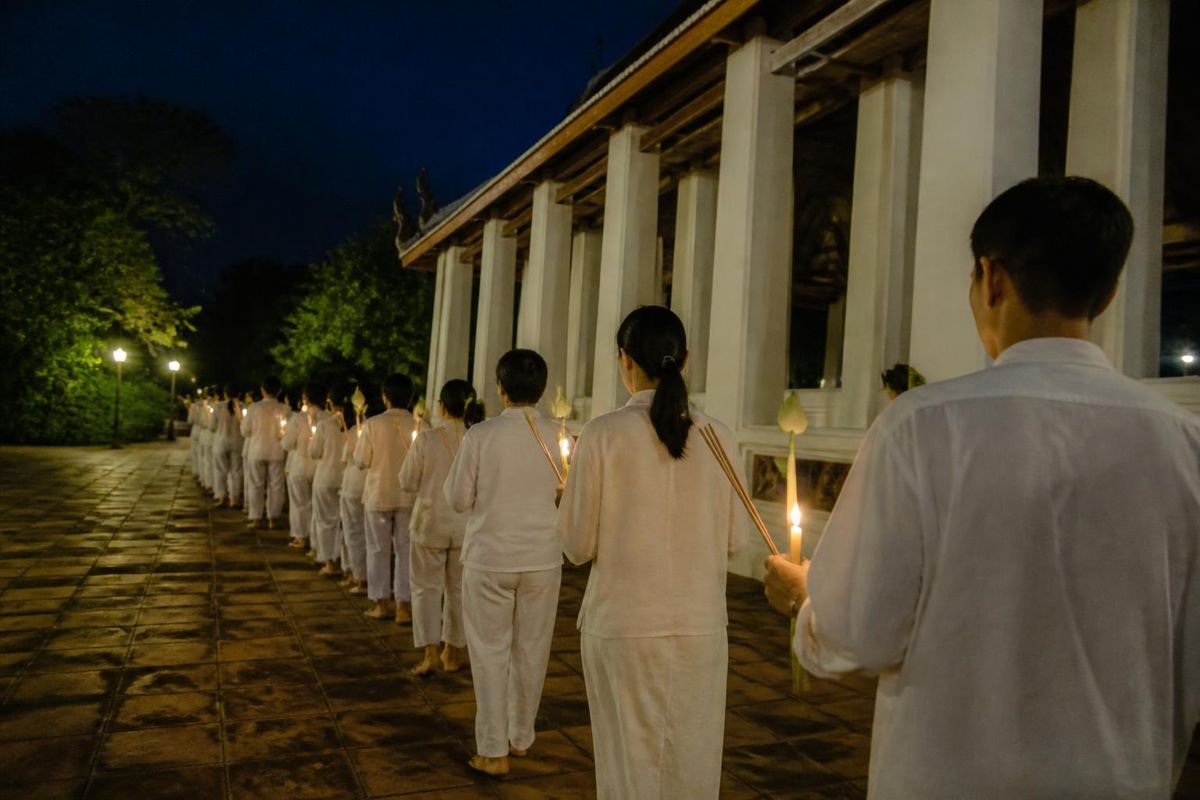
Walked slowly and attentively, the procession is a kind of walking meditation: the warmth of the flame, each step, the quiet voices around you. If you cannot go to a temple, you can sit with a candle before a Buddha image at home and recollect the three jewels with a quiet mind.
A reflection: the Buddha's last words
Because Vesak also remembers the Buddha's final passing, it is a good day to recall his last words, spoken to the monks gathered around him at Kusinārā:
Handa dāni, bhikkhave, āmantayāmi vo,
vayadhammā saṅkhārā appamādena sampādethā.Come now, monks, I tell you: all conditioned things are bound to pass away. Bring the work to completion through heedfulness.
DN 16
Vayadhammā saṅkhārā: everything made of conditions, the body included, is bound to break up. Appamādena sampādetha: so complete the work with heedfulness (appamāda), the steady care that does not let the moment slip by. On a day of candles and flowers, these two lines bring the celebration back to practice. The flowers will fade and the candle will burn down; the time to practise is now. You can read the whole scene, with a full translation, on the page on the Buddha's last words.
Keeping the day at home
You do not need to be at a temple to keep Vesak well. A simple plan for the day:
- In the morning, pay homage to the Buddha, recite the three refuges and take the five precepts for the day.
- Give something: food to monks if there is a temple near you, or help to someone in need.
- Read one discourse slowly, for example the first sermon on the Four Noble Truths.
- Set aside time for sitting and walking meditation, even thirty minutes.
- In the evening, light a candle before a Buddha image and recollect the qualities of the Buddha, Dhamma and Saṅgha; if you can, join a candle procession at a temple.
- Before sleep, recall the last words: all conditioned things pass away; practise with care.
Kept this way, Vesak is not only a day to remember the Buddha's life, but a day to walk a little further on the path he found.
Based on: Mahāparinibbāna Sutta (DN 16) · Ariyapariyesana Sutta, the Noble Search (MN 26)
Read next
Pacchima Ovāda: the Buddha's last words
The last teaching before the Buddha's final passing, from the Mahāparinibbāna Sutta
Buddham Saranam Gacchami: the Three Refuges with Meaning
Buddham saranam gacchami: the Pali chant of the three refuges from the Khuddakapāṭha, with the meaning of each line and what going for refuge means
Ovāda Pāṭimokkha: the heart of the Buddhas' teaching
Three Dhammapada verses that sum up the teaching of all the Buddhas, with the meaning