What is the Tipitaka? The Pali Canon's three baskets, Vinaya, Suttas and Abhidhamma, how the texts were kept, and how to start reading
The Tipitaka is the scripture of Theravada Buddhism: the teachings of the Buddha and his disciples as they were remembered, recited and finally written down in Pali. The Tipitaka is the most complete early collection of the Buddha's teaching that survives in an Indian language. The name means 'three baskets': the Vinaya, the training rules for monks and nuns; the Suttas, the Buddha's discourses; and the Abhidhamma, a systematic analysis of mind and matter. Because it is in Pali, the Tipitaka is also called the Pali Canon. This page explains what is in each basket, how the Tipitaka was kept by memory and then in writing, how the commentaries relate to it, and where a beginner can start.
What is the Tipitaka?
Ti means three and piṭaka means a basket, and by extension a collection: each basket holds one kind of text. The Sanskrit form of the name, Tripiṭaka, is also common in English. The word Pali itself first meant 'the text', the words of the canon as opposed to their explanation, and only later became the name of the language. Pali is a Middle Indian language close to what was spoken in northern India in the Buddha's time; the Theravada tradition identifies it with Māgadhī, the language of Magadha, where the Buddha spent much of his life.
The Buddha himself called what he taught dhamma-vinaya, 'the teaching and the training'. In the Mahāparinibbāna Sutta he tells Ānanda that, once he is gone, some may think they no longer have a teacher, but that this is not the way to see it, and says:
Yo vo, ānanda, mayā dhammo ca vinayo ca desito paññatto,
so vo mamaccayena satthā.Ānanda, the teaching and the training that I have taught and laid down for you will be your teacher when I am gone.
DN 16
The Tipitaka is the record of that teaching and training. Tradition counts the contents of the Tipitaka as 84,000 units of Dhamma (dhammakkhandha): 21,000 in the Vinaya, 21,000 in the Suttas and 42,000 in the Abhidhamma. In print it is large: the Pali Tipitaka in Thai script runs to 45 volumes, 8 for the Vinaya, 25 for the Suttas and 12 for the Abhidhamma, and other editions divide it differently.
The Vinaya Pitaka: the monastic training
The Vinaya Pitaka holds the rules of the monastic community and the stories of how each rule came about. Almost every rule begins with an incident: a monk or nun did something that caused harm or complaint, the matter was brought to the Buddha, and he laid down a rule, often refining it later. This makes the Vinaya a lively picture of daily life in the early community. Its main parts are:
- Suttavibhaṅga: the analysis of the Pāṭimokkha rules, 227 for monks and 311 for nuns, with the story behind each rule and a word-by-word explanation.
- Khandhaka: the Mahāvagga and Cūḷavagga, on ordination, the fortnightly recitation, the rains retreat, robes, medicine, settling disputes, and the accounts of the first two councils.
- Parivāra: a summary and study guide to the rest of the Vinaya.
In the editions of the Tipitaka used in Thailand and Myanmar, the Vinaya is printed as five books: Pārājika, Pācittiya, Mahāvagga, Cūḷavagga and Parivāra.
The Sutta Pitaka and the five nikayas
For most readers the Sutta Pitaka is the heart of the Tipitaka. It holds the discourses the Buddha gave to monks, nuns, lay people, brahmins and wandering ascetics, and some given by leading disciples such as Sāriputta. They are arranged in five collections (nikāya):
- Dīgha Nikāya, the long discourses: 34 suttas, including the Mahāparinibbāna Sutta on the Buddha's last months.
- Majjhima Nikāya, the middle-length discourses: 152 suttas, including the Satipaṭṭhāna Sutta on mindfulness (MN 10).
- Saṁyutta Nikāya, the connected discourses: thousands of shorter suttas grouped by subject, such as the aggregates, dependent origination and the noble truths. The first sermon is here (SN 56.11).
- Aṅguttara Nikāya, the numbered discourses: suttas arranged by the number of items they discuss, from ones up to elevens.
- Khuddaka Nikāya, the minor collection: between 15 and 18 books depending on the edition, including the Dhammapada, the Udāna, the Itivuttaka, the Sutta Nipāta, the verses of the elder monks and nuns, and the Jātaka.
The Abhidhamma Pitaka: seven books
The Abhidhamma Pitaka restates the teaching in exact, technical terms. Instead of 'I' and 'you', it speaks of moments of consciousness, mental factors and material qualities, and of how they condition one another. The Theravada tradition holds that the Buddha taught the Abhidhamma and that Sāriputta passed it on; historians see the books as a later systematic working-out of the lists found in the suttas. Its seven books are:
- Dhammasaṅgaṇī: a classification of all states as wholesome, unwholesome or neither.
- Vibhaṅga: a detailed analysis of topics such as the aggregates, sense bases, elements and truths.
- Dhātukathā: how each state relates to the aggregates, sense bases and elements.
- Puggalapaññatti: types of persons, described by their qualities.
- Kathāvatthu: debates rejecting views the Theravada elders held to be mistaken; by tradition it was compiled at the Third Council.
- Yamaka: questions set in pairs to fix the exact meaning of terms.
- Paṭṭhāna: the 24 kinds of conditional relation between states, the largest of the seven books.
The opening passages of the seven books make up the Abhidhamma chant often heard at funerals; you can read it with a translation on the page the Abhidhamma chant.
How the Pali Canon was kept: councils and recitation
For its first centuries the Tipitaka existed only in memory. Monks learnt the texts by heart and recited them together, which is why the suttas are full of repeated phrases, refrains and numbered lists: they helped many people hold exactly the same words. The Buddha had already given a test for any claim about his teaching. In the Mahāparinibbāna Sutta he says that when someone claims to have heard a teaching from the Buddha himself, it should be neither welcomed nor rejected at once, but checked:
tāni padabyañjanāni sādhukaṁ uggahetvā
sutte osāretabbāni, vinaye sandassetabbāni.Having learnt those words and phrases carefully, you should check them against the discourses and compare them with the training.
DN 16
If they fit, they can be accepted as the Buddha's word; if not, they should be set aside. The Vinaya's own account of the first council says that a few months after the Buddha's final passing, 500 arahants met at Rājagaha under Venerable Mahākassapa. Venerable Upāli, the expert on the training, answered questions on the Vinaya, and Venerable Ānanda, for many years the Buddha's attendant, answered questions on the discourses. The assembly then chanted them together: the Pali word for a council, saṅgīti, means 'chanting together', and in Thai a council is called saṅgāyanā.
About a hundred years later a second council at Vesālī settled a dispute about monastic rules, and the Theravada tradition counts a third council at Pāṭaliputta in the third century BCE. After that, groups of reciters (bhāṇaka) each took charge of one collection, such as the reciters of the Long Discourses, and passed it on from teacher to pupil.
When was the Tipitaka written down?
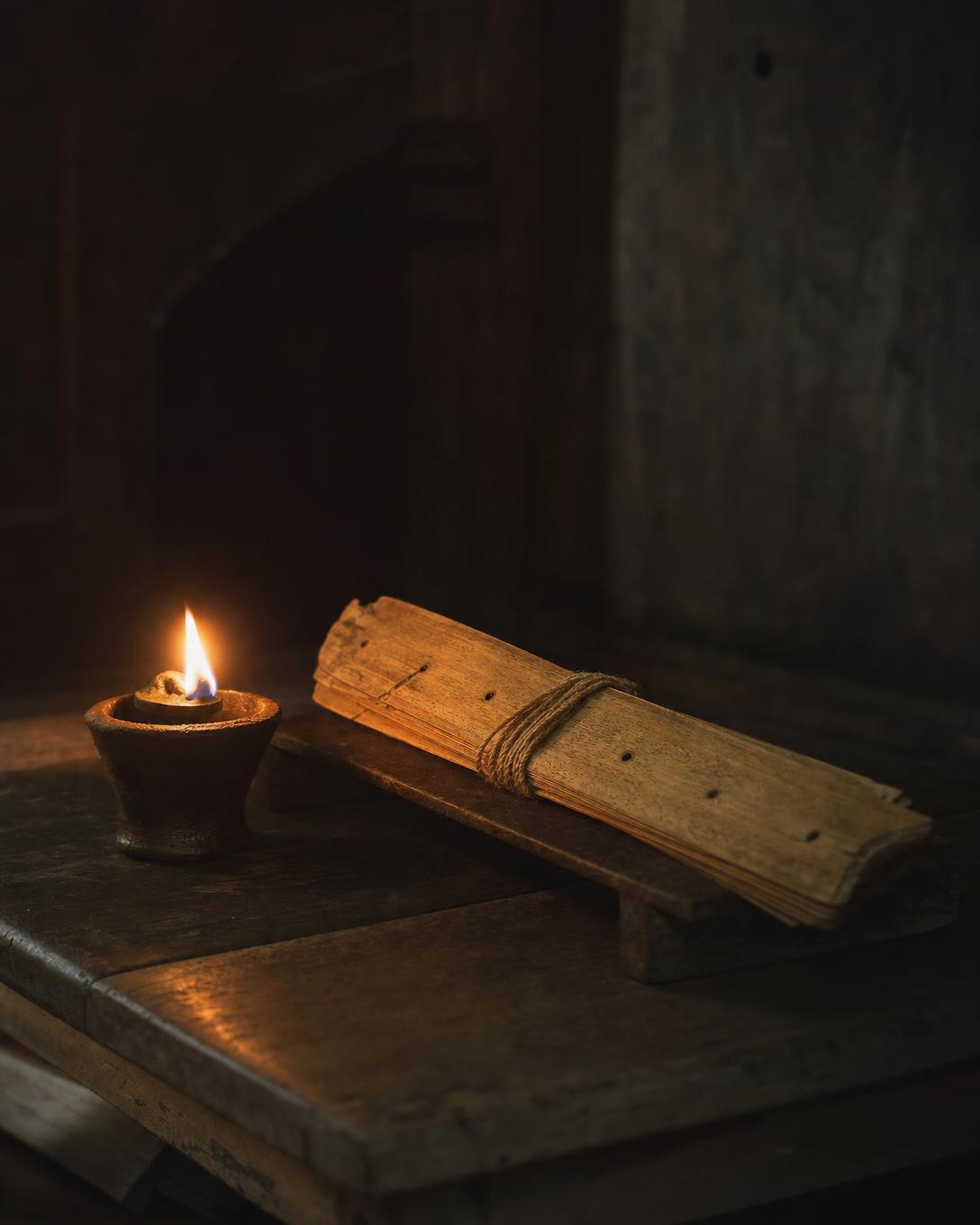
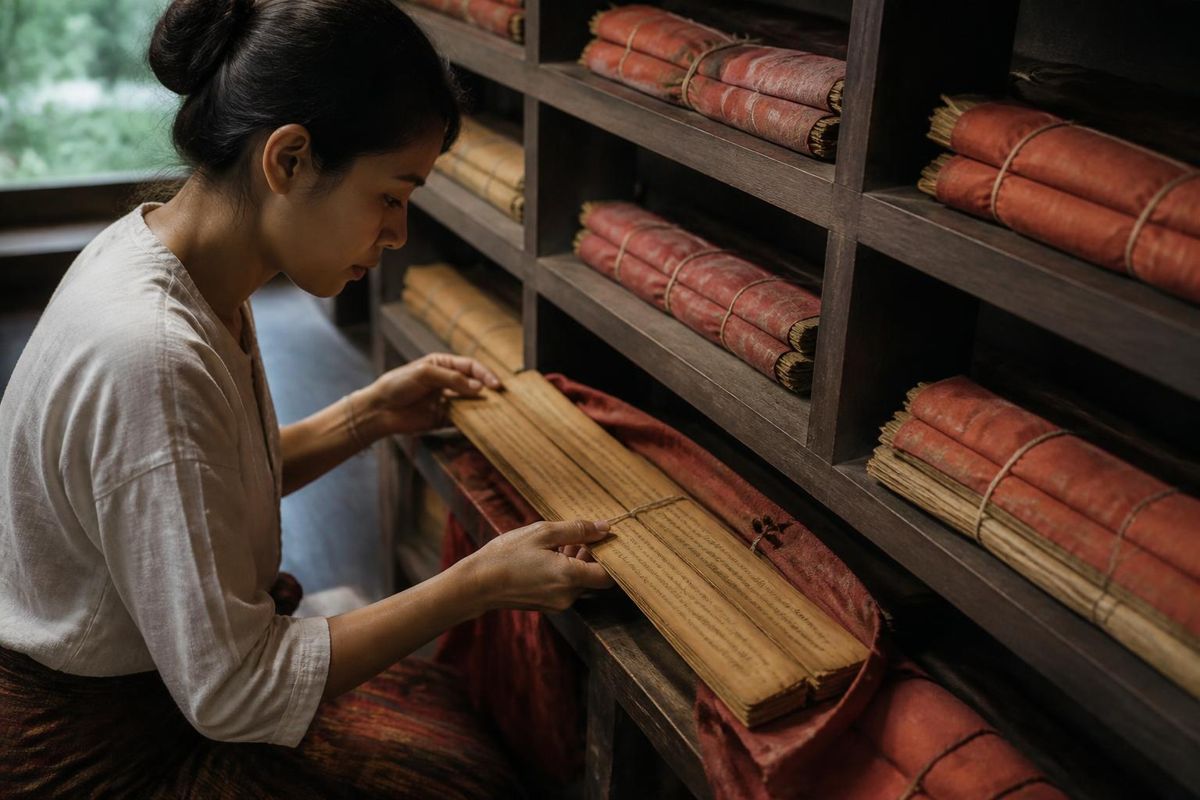
The old Sri Lankan chronicles record that in the first century BCE, after war and famine had made monks fear that the line of reciters might be broken, the Tipitaka and its commentaries were written down on palm leaves. Tradition places this at Aluvihāra, a cave monastery in central Sri Lanka. Palm-leaf manuscripts like those in the photo above remained the usual form of the Tipitaka for nearly two thousand years, copied by hand again and again as the leaves wore out.
Printed editions appeared from the late nineteenth century. Today the whole Pali Tipitaka can be read online free of charge in several scripts, with translations into many languages. The Pali quoted on this site comes from the Mahāsaṅgīti edition published on SuttaCentral.
The commentaries
Around the Tipitaka stands a large body of explanation. The commentaries (aṭṭhakathā) explain words, tell the background stories and settle points of doctrine. They were handed down in Sinhala in Sri Lanka and put into Pali in the fifth century CE, mostly by Buddhaghosa, who also wrote the Visuddhimagga, a guide to the whole path, and by later commentators such as Dhammapāla. Sub-commentaries (ṭīkā) explain the commentaries in turn. Theravada teachers rely on these works, but they are not part of the Tipitaka itself. On this site, 'the suttas say' means the canon; when we draw on the commentaries, we say so.
How to start reading the Pali Canon
Nobody starts by reading the Tipitaka from cover to cover. A gentle way in:
- Start with the Dhammapada, 423 short verses on ethics and the mind, arranged by theme.
- Read the Buddha's first teachings: the first sermon on the Four Noble Truths, then the discourse on the characteristic of not-self.
- Add a few practical suttas, such as the Discourse on Loving-kindness, the Kālāma Sutta and the Discourse on Blessings.
- Then take one collection slowly, for example one sutta of the Majjhima Nikāya a day, with a reliable translation, and look at the Pali when a word matters.
- Read with practice: after each sutta, ask what it asks you to do, and try it.
Read with an open but testing mind. The Tipitaka itself does not ask for blind acceptance: in the Kalama Sutta, one of the ten things the Buddha says not to go by on their own is the authority of a scripture.
Etha tumhe, kālāmā, mā anussavena, mā paramparāya,
mā itikirāya, mā piṭakasampadānena …Come, Kālāmas: do not go by what you have heard again and again, nor by tradition, nor by hearsay, nor by what is in a scripture …
AN 3.65
The test he gives instead is practical: whether a teaching, put into practice, leads to welfare and happiness or to harm and suffering. The Tipitaka is best read the same way, as a map to be walked, not only a book to be believed.
Based on: Mahāparinibbāna Sutta (DN 16) · Kesamutti Sutta (to the Kālāmas) (AN 3.65) · Vinaya Piṭaka, Cūḷavagga, the account of the First Council · Visuddhimagga, by Buddhaghosa
Read next
The Abhidhamma Chant: the Seven Books
The Abhidhamma chant heard at funerals: the opening passage of each of the seven Abhidhamma books, in Pali with a new translation

What is Theravada Buddhism? The teaching of the elders
What is Theravada Buddhism? The meaning of the name, its scriptures, core teachings, monastic and lay life, practice, where it is found and how it differs from Mahayana

Dhammacakkappavattana Sutta: the Pali chant with translation, and its meaning
The Dhammacakkappavattana Sutta, the Buddha's first sermon, on the middle way and the four noble truths: the Pali with a translation of every section