The full Jinapañjara chant, all 15 verses in Pali with reading and a translation of each verse, with its origin, its meaning and how to chant it once, 3 or 9 times
The Jinapañjara is a Pali chant of fifteen verses in which the chanter pictures the twenty-eight Buddhas, the Dhamma, the Saṅgha, the great disciples and the protective chants set on the head, in the eyes, at the chest and all around the body, until they form something like a cage enclosing the chanter on every side. It is one of the most widely chanted texts in Thailand. Below this introduction is the full Jinapañjara, one complete round of all fifteen verses, opening with the homage to the Buddha, with the Pali and its reading and a translation of each verse. This section explains the name, where the chant comes from, what each verse says, the disciples and protective chants it names, how to chant it, and questions people often ask, such as how many rounds to chant and whether there is a short version.
What is the Jinapañjara, and what does the name mean?
The name comes from two Pali words: jina, 'conqueror', a name for the Buddha, who conquered the defilements and Māra, and pañjara, 'cage', a frame that encloses something on all sides. Jinapañjara therefore means 'the Conqueror's cage', the enclosure of the Buddha. The whole picture in the chant is of the chanter at the centre with the Buddha, the Dhamma, the Saṅgha and the disciples all around. The word appears in the text itself, in verse 14 and in the last verse, which ends carāmi jinapañjare, 'I live within the Conqueror's enclosure'; verse 13 says sambuddhapañjare with the same meaning.
In Pali, gāthā means a verse, words composed in lines according to a metre, so the Thai name khatha chinabanchon means 'the verses of the Conqueror's enclosure'. All of its content is a recollection of the Triple Gem, the Buddha, the Dhamma and the Saṅgha, through images that are easy to remember: the chanter does not just say the sounds but pictures each part of the body in turn.
Where the Jinapañjara comes from
The Jinapañjara is not in the Tipiṭaka. It is a later composition in Pali, written long after the Buddha's time in Pali words and metre. In Thailand it is traditionally associated with Somdet Phra Phutthachan (To Phrommarangsi) as the one who made it widely known. Who composed it, and where and when, is not certain.
Because the chant has been passed down through many chanting books, the wording differs slightly from one edition to another. This page uses wording checked against the edition on Thai Wikisource. Many Thai chanting books print two lines of wishes before verse 1, beginning puttakāmo labhe puttaṁ. Those lines are not part of the fifteen verses, so this page gives only the homage to the Buddha followed by the fifteen verses.
What the 15 verses of the Jinapañjara say
The Jinapañjara arranges its images from top to bottom and from the inside out: it begins with the Buddhas on the head and widens until there are walls and a roof. Its content falls into seven parts:
- Verses 1 and 2: the Buddhas who defeated Māra and drank the taste of the four noble truths, and the twenty-eight Buddhas beginning with Taṇhaṅkara, set on the crown of the head.
- Verse 3: the Buddha on the head, the Dhamma in the two eyes and the Saṅgha at the chest. This verse is the core of the whole picture.
- Verses 4 to 8: fifteen great disciples, placed at the heart, on the right, at the back, on the left, at the right ear, the left ear, the back of the head, the mouth and the forehead.
- Verse 9: eighty more great elders, shining with virtue, set in every limb.
- Verses 10 and 11: seven protective chants surround the body as walls on four sides and a roof in the sky.
- Verses 12 and 13: seven walls joined with the Conqueror's authority, and the wish that troubles from outside and within come to an end while the chanter goes about their own tasks.
- Verses 14 and 15: the wish that all the great beings watch over the chanter, and the closing verse: the chanter lives within the Conqueror's enclosure by the power of the Buddha, the Dhamma and the Saṅgha.
Verses 12 and 13 speak of troubles arising from wind, bile and so on, which is how illness was described when the chant was written. These words are a wish, not a treatment: when you are ill, see a doctor as usual, and let chanting be a support for the mind alongside it.
The disciples named in the chant
The disciples in verses 4 to 8 are people whose stories are in the Tipiṭaka, and many were praised by the Buddha as foremost in some quality, as collected in the chapter on the foremost (etadagga) in the Aṅguttara Nikāya. Knowing who each one was helps you chant with understanding.
- Sāriputta and Moggallāna, the chief disciples of the right and the left, foremost in wisdom and in psychic power; in the chant, too, they stand at the chanter's right and left.
- Koṇḍañña, the first to understand the Dhamma on hearing the first sermon, so that the Buddha exclaimed, 'Koṇḍañña has understood!'
- Ānanda, the Buddha's attendant, who remembered a great deal of the teaching, and Rāhula, the Buddha's son, foremost in the wish to train.
- Anuruddha, foremost in the divine eye, and Upāli, foremost in knowing the monastic discipline.
- Kumārakassapa, foremost in teaching in many varied ways, whom the chant calls cittavādako.
- Aṅgulimāla, the former bandit whom the Buddha went to meet and who changed his life and became a monk; Sīvali, foremost in receiving gifts; and Nanda, foremost in guarding the senses.
As for Kassapa, Mahānāma and Puṇṇa, there are several elders of these names in the Tipiṭaka, and the chant does not make clear which ones it means.
The seven protective chants that form the walls
Verses 10 and 11 name seven chants, all of them protective chants (paritta) that are really recited and translated on this site: the Ratana Sutta in front, the Metta Sutta on the right, the Dhajagga Sutta behind, the Aṅgulimāla chant on the left, and the Khandha chant, the Mora chant and the Āṭānāṭiya chant as the roof. They all belong to the twelve protective chants.
The meaning of this picture becomes clearer when you read what those chants say. The Metta Sutta teaches spreading goodwill to all beings without limit; the Dhajagga Sutta teaches recollecting the Buddha, the Dhamma and the Saṅgha when fear arises; the Ratana Sutta speaks of the qualities of the Triple Gem. So the walls in the Jinapañjara are built of teachings, and the one who understands and uses these teachings is the one who really lives inside them.
Chanting the Jinapañjara once, 3, 9 or 108 times
One round of the Jinapañjara means all fifteen verses once. By custom you begin with the homage Namo tassa three times, which opens the chant below. At a normal pace one round takes only a few minutes. The chant below is one full round; whatever number of rounds you choose, you repeat this same text.
Many people chant it three or nine times a day as a custom, and some set out to chant it 108 times on special days, using prayer beads to count. These numbers are customs handed down; the chant itself sets no number and does not say what any number of rounds will bring. What it actually describes is keeping the Buddha, the Dhamma and the Saṅgha with you in every part of yourself. One round with the mind on the meaning is therefore closer to the chant's content than many rounds with the mind elsewhere.
If you chant nine rounds, it helps to say the first slowly, picturing the meaning, and the rest at an even pace, counting on your fingers or with beads so you need not worry about the number. The reading given for each line can be used for every round.
Is there a short version of the Jinapañjara?
The text has fifteen verses, and no short form is part of the text itself. What people call a short version is a selection of some verses or lines. If you have little time, the best choice is one full round said with attention, which does not take long. If you really need something shorter, you could say verse 3, which places the Buddha, the Dhamma and the Saṅgha on the head, in the eyes and at the chest, and verse 15, the closing verse. These two keep the heart of the picture; chant the full text when you have time.
How to chant the Jinapañjara
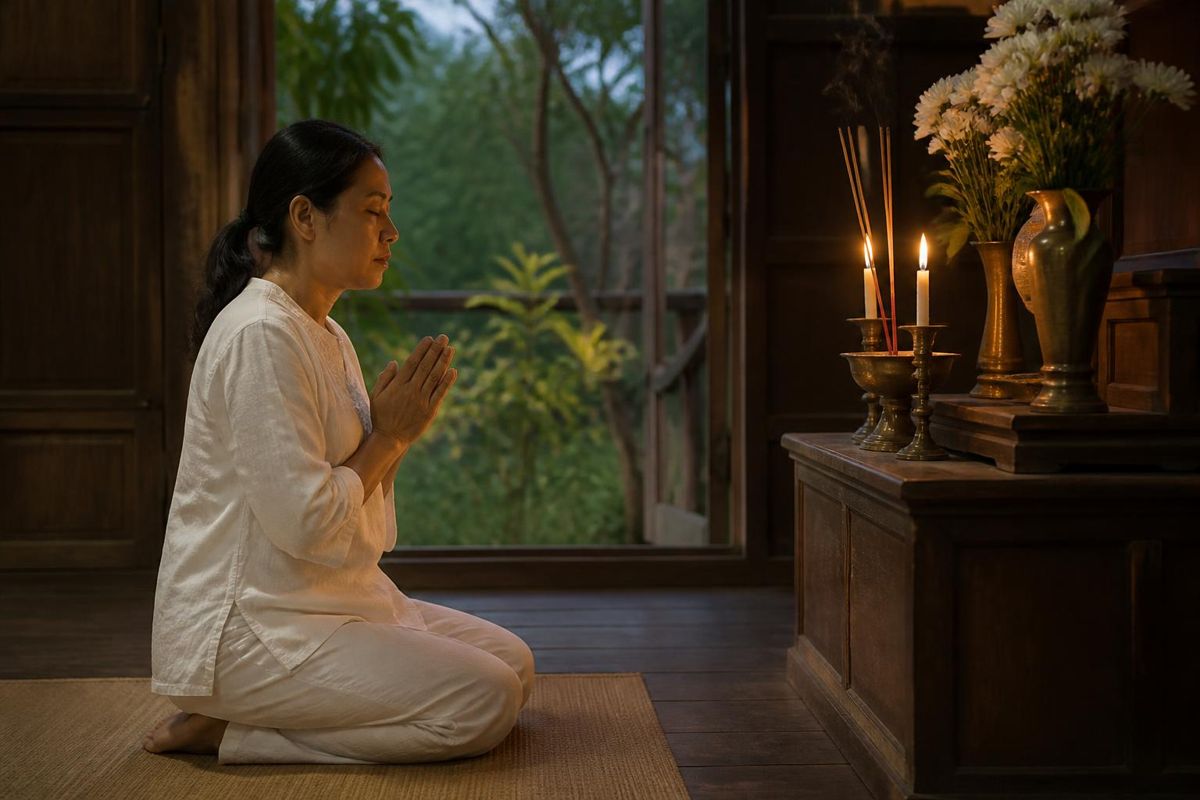
- Find a quiet place, before a Buddha image or a home altar if you have one, or anywhere you can sit comfortably: on the floor with your legs folded to one side, kneeling, or on a chair.
- Bow three times or join your palms, then say the homage Namo tassa bhagavato arahato sammāsambuddhassa three times.
- Chant one verse at a time from the reading, slowly enough to pronounce each word clearly. If you are not yet fluent, read the verse's translation first and then chant it.
- As you chant, picture what the words say: at verse 3, for example, bring to mind the Buddha on your head, the Dhamma in your eyes and the Saṅgha at your chest.
- When you finish, sit still for a moment; you may then continue with spreading loving-kindness or dedicating the merit.
Your pronunciation does not have to be perfect on the first day. The reading below divides the syllables the way they are chanted in Thailand, for example jayāsanāgatā buddhā, and with daily repetition it becomes fluent. To get the rhythm, chanting together with others, at home or at a temple, helps a great deal.
The Jinapañjara as recollection of the Triple Gem
In the Tipiṭaka, recollecting the Buddha, the Dhamma and the Saṅgha is a way of training the mind, called recollection of the Buddha, of the Dhamma and of the Saṅgha. In AN 6.10 the Buddha says that while a noble disciple recollects the Realised One, their mind is not overcome by greed, hatred or delusion; it stays upright, resting on what it recalls. Though composed much later, the Jinapañjara works on the same principle, through images the chanter can follow.
So when the last verse says the chanter is kept by the power of the true Dhamma, it can be read as the Dhamma looking after those who live by it, not as a promise that nothing bad will happen. Putting the chant to real use means keeping the Buddha at the centre of your thinking, looking at things through the Dhamma, and holding the Saṅgha in your heart as an example, as verse 3 pictures it.
Chants often recited with it
In chanting at home, many people say the Jinapañjara after the Itipiso chant, which recollects the qualities of the Buddha, the Dhamma and the Saṅgha one by one, and the Bāhuṁ chant, which tells of the Buddha's eight victories, and then close by spreading loving-kindness. The three fit well together: the first says what the qualities of the Triple Gem are, the second tells how those qualities overcame violence and delusion, and the third places them all around the chanter. For a fuller daily set, see the daily chants.
The chant
Homage to the Buddha
Namo tassa bhagavato arahato sammāsambuddhassa.
Say 3 timesMeaning
Homage to the Blessed One, the perfected one, the fully awakened Buddha.
Verse 1
Jayāsanāgatā buddhā, jetvā māraṁ savāhanaṁ,
catusaccāsabhaṁ rasaṁ, ye piviṁsu narāsabhā.
Meaning
The Buddhas, the bulls among men, who came to the seat of victory, defeated Māra and his mount, and drank the finest taste: the four noble truths.
Verse 2
Taṇhaṅkarādayo buddhā, aṭṭhavīsati nāyakā,
sabbe patiṭṭhitā mayhaṁ, matthake te munissarā.
Meaning
The twenty-eight Buddhas, the leaders, beginning with Taṇhaṅkara: all those lords of sages are set on the crown of my head.
Verse 3
Sīse patiṭṭhito mayhaṁ, buddho dhammo dvilocane,
saṅgho patiṭṭhito mayhaṁ, ure sabbaguṇākaro.
Meaning
The Buddha is set on my head, the Dhamma in my two eyes, and the Saṅgha, the source of every good quality, is set on my chest.
Verse 4
Hadaye me anuruddho, sārīputto ca dakkhiṇe,
koṇḍañño piṭṭhibhāgasmiṁ, moggallāno ca vāmake.
Meaning
Anuruddha is in my heart, Sāriputta on my right, Koṇḍañña at my back and Moggallāna on my left.
Verse 5
Dakkhiṇe savane mayhaṁ, āsuṁ ānandarāhulā,
kassapo ca mahānāmo, ubhāsuṁ vāmasotake.
Meaning
Ānanda and Rāhula are at my right ear; Kassapa and Mahānāma, the two of them, are at my left ear.
Verse 6
Kesante piṭṭhibhāgasmiṁ, suriyo va pabhaṅkaro,
nisinno sirisampanno, sobhito munipuṅgavo.
Meaning
At the back of my head, where the hair ends, sits Sobhita, the foremost of sages, full of glory, shining like the radiant sun.
Verse 7
Kumārakassapo thero, mahesī cittavādako,
so mayhaṁ vadane niccaṁ, patiṭṭhāsi guṇākaro.
Meaning
The elder Kumārakassapa, the great seer with the gift of fine speech, a mine of good qualities, is always set in my mouth.
Verse 8
Puṇṇo aṅgulimālo ca, upālī nandasīvalī,
therā pañca ime jātā, nalāṭe tilakā mama.
Meaning
Puṇṇa, Aṅgulimāla, Upāli, Nanda and Sīvali: these five elders appear as marks on my forehead.
Verse 9
Sesāsīti mahātherā, vijitā jinasāvakā,
etesīti mahātherā, jitavanto jinorasā,
jalantā sīlatejena, aṅgamaṅgesu saṇṭhitā.
Meaning
The remaining eighty great elders, the victorious disciples of the Conqueror (the Buddha), these eighty great elders who have won, true sons of the Conqueror, blazing with the power of virtue, are set in each of my limbs.
Verse 10
Ratanaṁ purato āsi, dakkhiṇe mettasuttakaṁ,
dhajaggaṁ pacchato āsi, vāme aṅgulimālakaṁ.
Meaning
The Ratana Sutta is in front, the Metta Sutta on the right, the Dhajagga Sutta behind and the Aṅgulimāla chant on the left.
Verse 11
Khandhamoraparittañca, āṭānāṭiyasuttakaṁ,
ākāse chadanaṁ āsi, sesā pākārasaṇṭhitā.
Meaning
The Khandha and Mora chants and the Āṭānāṭiya Sutta form a roof in the sky; the remaining chants stand as walls.
Verse 12
Jināṇāvarasaṁyuttā, sattapākāralaṅkatā,
vātapittādisañjātā, bāhirajjhattupaddavā.
Meaning
These chants, joined with the excellent authority of the Conqueror, are arranged as seven walls. As for troubles from outside and within, arising from wind, bile and other causes (the sentence continues in verse 13)…
Verse 13
Asesā vinayaṁ yantu, anantajinatejasā,
vasato me sakiccena, sadā sambuddhapañjare.
Meaning
…may they all come to an end, with nothing left, through the boundless power of the Conqueror, as I go about my own tasks, always within the enclosure of the Fully Awakened One.
Verse 14
Jinapañjaramajjhamhi, viharantaṁ mahītale,
sadā pālentu maṁ sabbe, te mahāpurisāsabhā.
Meaning
May all those great men, the bulls among men, always watch over me as I live on this earth in the middle of the Conqueror's enclosure (jinapañjara).
Verse 15
Iccevamanto sugutto surakkho,
jinānubhāvena jitupaddavo,
dhammānubhāvena jitārisaṅgho,
saṅghānubhāvena jitantarāyo,
saddhammānubhāvapālito,
carāmi jinapañjareti.
Meaning
Thus, well guarded and well kept, by the power of the Conqueror I have overcome troubles, by the power of the Dhamma I have overcome the host of foes, by the power of the Saṅgha I have overcome dangers. Kept by the power of the true Dhamma, I live within the Conqueror's enclosure.
Machine translation from: The Jinapañjara verses (Thai Wikisource) · A later Pali composition, not part of the Tipiṭaka, traditionally linked to Somdet Phra Phutthachan (To Phromrangsi) · With Mahānāma (AN 6.10) · Rolling Forward the Wheel of Dhamma (SN 56.11) · The chapter on the foremost disciples, Aṅguttara Nikāya, Book of the Ones
Read next
The Itipiso Chant with Translation: the Qualities of the Buddha, Dhamma and Saṅgha
The Itipiso chant in Pali with reading and translation: the Buddha's 9 qualities, the Dhamma's 6 and the Saṅgha's 9, its source in the suttas, and chanting it 3, 9 or 108 times
The Bāhuṁ Chant: the eight Jayamaṅgala verses with translation and meaning
The Bāhuṁ chant, the eight Jayamaṅgala verses, in Pali with reading and translation, the story behind each of the Buddha's victories, and how to chant it
The Twelve Protective Chants: Inviting the Devas
The invitation to the devas chanted before the protective chants, in both the twelve-chant and seven-chant sets, with meanings. The twelve are the Maṅgala, Ratana, Metta, Khandha, Mora, Vaṭṭaka, Dhajagga, Āṭānāṭiya, Aṅgulimāla, Bojjhaṅga, Abhaya and Jaya chants.