
The three marks of existence, impermanence, unsatisfactoriness and not-self, explained with their sources in the suttas and everyday examples
The three marks of existence are three characteristics found in all conditioned things: impermanence (anicca), unsatisfactoriness or suffering (dukkha), and not-self (anattā). The body, feelings, thoughts and the things around us all carry these three marks. Seeing them for yourself, not just remembering them, is the heart of insight practice. This page explains what the three marks of existence mean, each mark in turn, why they are called a law, with passages from the suttas, everyday examples and why the teaching is worth studying.
What are the three marks of existence?
The Thai name, trai-lak, joins 'three' and 'mark', matching the Pali tilakkhaṇa. A mark (lakkhaṇa) is the feature by which you recognise what something is, the way heat marks fire. So the three marks of existence are not something the Buddha invented; they are already present in things, and he pointed them out. In English they are usually called the three marks of existence or the three characteristics.
In the Navakovada, the standard first-level Dhamma textbook in Thailand, the three marks appear among the groups of three under the name 'common characteristics'. Its text, quoted as it stands, reads:
- The characteristics shared equally by all conditioned things are called the common characteristics, also called the three characteristics. They are divided into three:
- Aniccatā: being impermanent.
- Dukkhatā: being suffering.
- Anattatā: being not-self.
Common here means shared, or equal. Every conditioned thing, small or large, a rich man's or a poor man's, has these three marks in equal measure. Conditioned things (saṅkhārā) here means everything produced by causes and conditions, a wider sense than the fourth aggregate of the same name. The forms heard in chanting are aniccaṁ, dukkhaṁ, anattā; the Navakovada uses the abstract nouns ending in -tā, 'the state of being'. The meaning is the same.
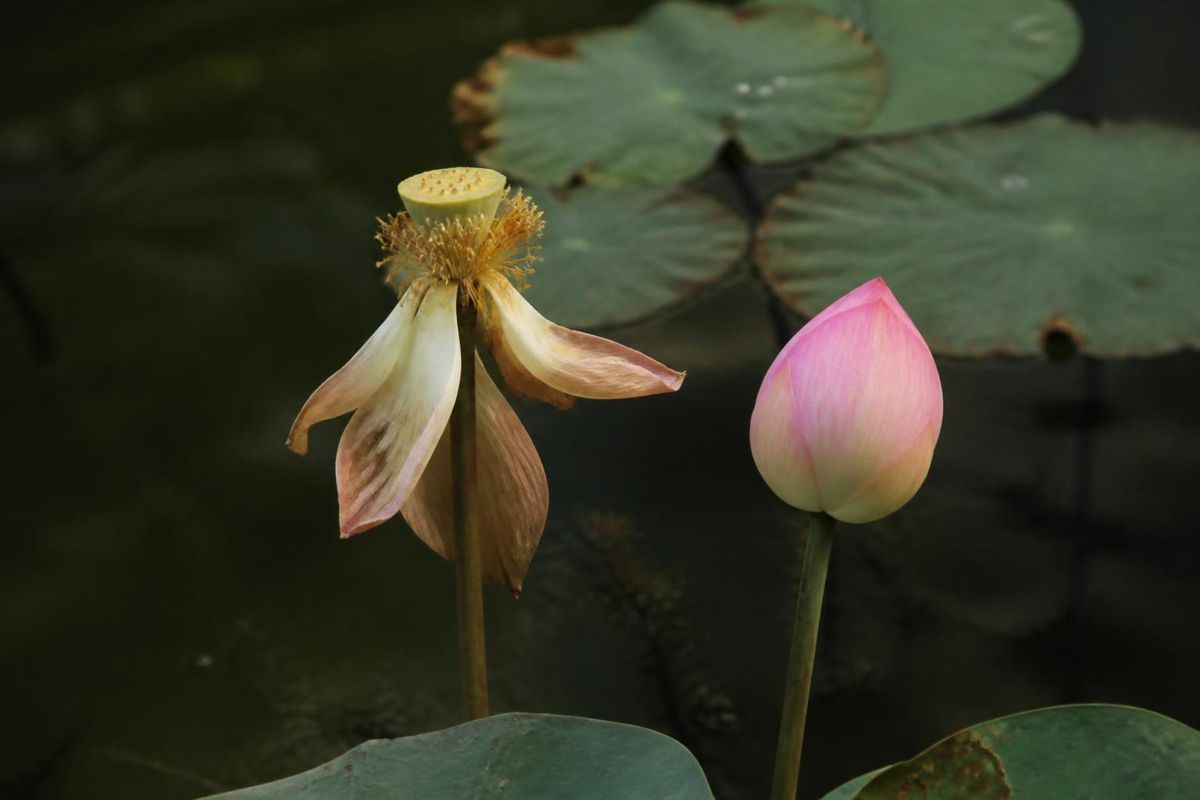
The three marks of existence at a glance
- Anicca, impermanence: everything that arises changes and passes away; no conditioned thing stays the same even for a moment.
- Dukkha, unsatisfactoriness: pressed by arising and passing, unable to stay as it is, and so never a lasting refuge.
- Anattā, not-self: no lasting core that owns it; it cannot be ordered about and follows its causes.
The three form one line of reasoning: because things are impermanent, they are unsatisfactory; because they are impermanent and unsatisfactory, they are not fit to be taken as 'my self'. This is the same order the Buddha follows when he questions the monks in the Discourse on the Characteristic of Not-Self.
Anicca: arising, persisting, passing away
Anicca is the easiest of the three marks of existence to see: everything that arises passes away. The Thai phrase 'arising, persisting, passing away' sums it up. In the Book of the Threes (AN 3.47) the Buddha names three features of conditioned things: their arising is evident, their vanishing is evident, and while they persist, their change is evident. The last point matters. 'Persisting' does not mean standing still; it is the stretch when a thing is still here and changing all the time.
Aniccā vata saṅkhārā,
uppādavayadhammino;
Uppajjitvā nirujjhanti,
tesaṁ vūpasamo sukho.Conditioned things are impermanent indeed; their nature is to rise and fall. Having arisen, they cease. Their stilling is happiness.
DN 16
Sakka, lord of the gods, spoke this verse at the moment the Buddha passed away. Even the Teacher's own body was subject to impermanence. The verse is part of the bangsukul chant said at funerals, as a reminder of this truth.
Impermanence can be seen at several levels. At the coarse level, people age, things break, seasons change. At a finer level, feelings, thoughts and moods change far faster than that. Anger that seems like one big lump turns out, when looked at closely, to be a stream of thoughts and feelings arising and passing one after another. Insight meditation gradually reveals arising and passing at this fine level.
Dukkha: unable to stay as it is
Dukkha as a mark does not mean everything hurts. A delicious ice cream has the mark of dukkha because it melts and is gone. The meaning is: pressed by arising and passing, unable to stay as it is, and so unable to give lasting satisfaction. Keep it distinct from painful feeling (dukkha-vedanā), physical or mental pain. Even a pleasant feeling has the mark of dukkha, because the pleasure itself does not last.
Tisso imā, āvuso, dukkhatā.
Dukkhadukkhatā, saṅkhāradukkhatā, vipariṇāmadukkhatā.Reverend, there are three forms of suffering: the suffering of pain, the suffering inherent in conditions, and the suffering of change.
SN 38.14
Of these three, the suffering inherent in conditions is closest to dukkha as a mark. Everything produced by conditions depends on them all the time; when the conditions change, the thing must change with them. That is why the first of the four noble truths sums up suffering as the five aggregates that are grasped at. There is more on the three forms on the dukkha page.
Anatta: not a self that can be commanded
Anattā is the deepest of the three marks, and a distinctive teaching of Buddhism. In the Discourse on the Characteristic of Not-Self the Buddha gives a simple argument: if the body really were our self, we would be able to command it.
Rūpaṁ, bhikkhave, anattā.
Rūpañca hidaṁ, bhikkhave, attā abhavissa,
nayidaṁ rūpaṁ ābādhāya saṁvatteyya,
labbhetha ca rūpe:
evaṁ me rūpaṁ hotu, evaṁ me rūpaṁ mā ahosīti.Mendicants, form is not-self. If form were self, it would not lead to affliction, and we could tell it: 'Let my form be like this; let it not be like that.'
SN 22.59
In fact the body falls ill, ages and changes without asking anyone's permission. The Buddha says the same of feeling, perception, choices and consciousness, the five aggregates in full. So anattā does not mean that nothing exists. Life goes on and actions have results, but there is no lasting core behind them that owns and controls them, only processes that follow their conditions. What anattā does and does not mean is covered on the page anatta: not-self.
Why the three marks are called a law
The phrase 'law of the three characteristics', common in Thai, is not a term from the canon itself, but it captures the meaning. In the Book of the Threes (AN 3.136) the Buddha says that whether or not Realised Ones arise, this truth stands as a fixed law of nature: all conditions are impermanent, all conditions are suffering, and all things are not-self. A Realised One awakens to it, then explains, teaches and makes it plain. That is why the three marks of existence are called a law: they hold whether anyone believes in them or not.
Look carefully at the wording. The first two statements speak of conditions (saṅkhārā), things that are put together. The third speaks of all things (dhammā), which includes the unconditioned, nibbāna. Nibbāna is not impermanent and not suffering, but it is not a self either. The same three lines appear in the Dhammapada, verses 277 to 279, each followed by: when one sees this with wisdom, one grows weary of suffering; this is the path to purity.
The three marks in everyday life
You do not have to wait for deep meditation. The three marks show up in ordinary things every day.
- Morning coffee: hot, then slowly cooling (anicca); the taste you enjoy doesn't last and you want another cup (dukkha); and you cannot order it to stay hot (anattā).
- A new phone: exciting on day one, ordinary three months later, and one day slow or broken. Both the excitement and the phone are impermanent.
- Moods in one day: bright in the morning, irritable by mid-morning, flat in the afternoon. Anger arrives by itself, keeps changing, and goes. We did not order it to come, and we cannot order it to leave.
- The body: grey hair, longer sight, aching knees. We did not order them, and we cannot order them to stop.
- Pain while meditating: looked at closely, it is not one solid lump. It grows, fades, moves and changes texture.
Noticing like this does not make life dull. It lets you enjoy good things fully while they are here, and let go more easily when they have to go.
The three marks of existence in insight meditation
Seeing the three marks for yourself is what makes vipassana different from thinking about Dhamma. The Visuddhimagga explains that each mark is hidden by something. Continuity hides impermanence; changing posture hides suffering, because we shift before discomfort becomes unbearable; and seeing things as solid wholes hides not-self. When mindfulness looks closely enough to see each moment separately, the three marks of existence become plain.
When the Buddha finished his first sermon, Koṇḍañña was the first to gain the vision of the Dhamma. What he saw fits in one line:
yaṁ kiñci samudayadhammaṁ,
sabbaṁ taṁ nirodhadhammanti.Whatever has the nature to arise, all of that has the nature to cease.
SN 56.11
In the Discourse on the Characteristic of Not-Self, once the monks see the three marks in all five aggregates, the sutta states what follows: disenchantment, the fading of desire, and freedom. Later meditation manuals arrange the knowledges that arise along the way as the 16 stages of insight. There is no need to grade yourself; simply keep seeing what is in front of you as it is.
Why study the three marks of existence?
- Meeting loss better: when you understand beforehand that everything changes, separation still hurts, but it does not bring the whole mind down.
- Less clinging, less suffering: much of our pain comes from expecting impermanent things to stay.
- Humility and fellow feeling: success, reputation and looks are all impermanent; no one stands above anyone else for good, and everyone lives under the same law.
- Not wasting time: knowing that time does not wait, you do the good thing today. This echoes the Buddha's last words: conditions fall apart; persist with diligence.
- The ground of wisdom: seeing the three marks is the seeing that loosens our grip on a self, which is what the whole practice aims at.
So the three marks are not pessimism but realism. Someone who knows that flowers wilt can still enjoy flowers, perhaps even more than before.
The three marks of existence in summary
In short, the three marks of existence are three features of all conditioned things. Anicca: everything arises, persists and passes away. Dukkha: what is impermanent cannot stay as it is, so it cannot be a lasting refuge. Anattā: nothing is a self we can command; everything follows its conditions, as dependent origination explains in detail. Knowing the three marks from memory is the start; seeing them with a settled mind is wisdom, and that wisdom leads to freedom from suffering.
Based on: Anattalakkhaṇa Sutta (SN 22.59) · Dhammacakkappavattana Sutta (SN 56.11) · Dukkhapañhā Sutta, a question about suffering (SN 38.14) · Mahāparinibbāna Sutta (DN 16) · Saṅkhatalakkhaṇa Sutta, characteristics of the conditioned (AN 3.47) · Uppāda Sutta, arising (AN 3.136) · Dhammapada, Chapter on the Path (Dhp 273–289) · Navakovada (public domain) · Visuddhimagga, by Buddhaghosa
Read next

What is vipassana? Meaning, origin and how to begin
What is vipassana? The meaning of the word, where the practice comes from, and how to begin
The Characteristic of Not-Self
The second sermon, on not-self

The 16 Stages of Insight (Vipassana Nana)
The 16 stages of insight: the knowledges that unfold in vipassana practice, with the nine insight knowledges